BC - 312 US Army communications receiver
MY VINTAGE EQUIPMENT
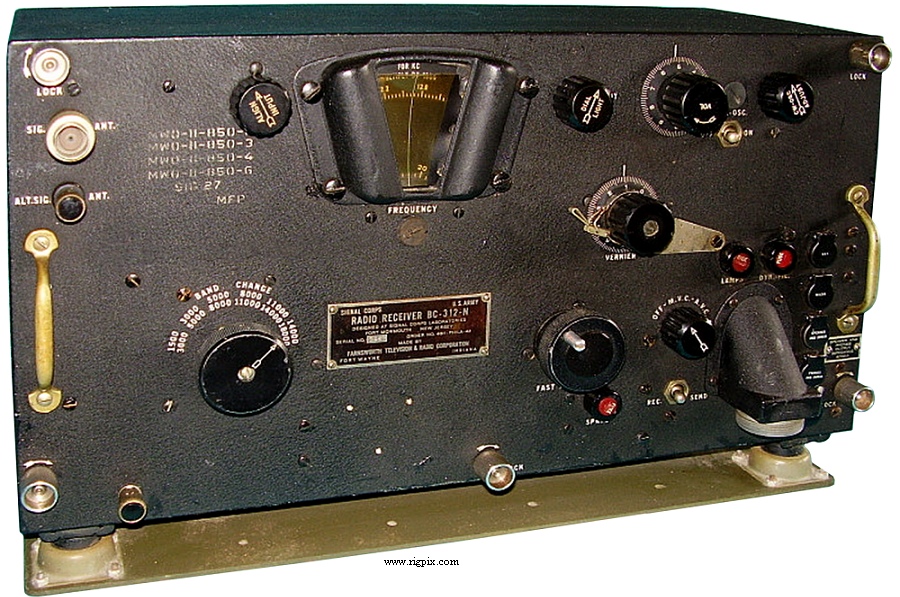
Owner Rudolf Bosnjak - E71RB, Sarajevo, Bosnia and Herzegovina.
INTRODUCTION
The BC-312 is a 9 valve communications receiver, a superheterodyne design
using single conversion. It was made in the USA, and designed at Fort
Monmouth, in the mid 1930s. It was intended for ground use, either
individually or with a transmitter. It can receive AM (amplitude modulation)
or CW (continuous wave) or MCW (modulated continuous wave) signals, and uses
the LS3 loudspeaker. It looks similar to the BC-348 airborne receiver,
having a wedge-shaped dial, but the radio is much larger, heavier, and very
different inside. The BC-312 weighs 48 pounds.
The receiver covers 1.5 to 18 mHz, in 6 ranges. They aree
Band A: 1.5 C 3.0 MHz
Band B: 3.0 C 5.0 MHz,
Band C: 5.0 C 8.0 MHz,
Band D: 8.0 C 11.0 MHz
Band E: 11.0 C 14.0 MHz
Band F: 14.0 C 18.0MHz.
It has two RF amplifiers (Radio Frequency) using VT-86 (6K7) valves, a
frequency changer using VT-87 (6L7) with a separate oscillator using a VT-65
(6C5), two IF amplifiers (Intermediate Frequency) using VT-86 (6K7), a
detector and audio pre-amplifier using a VT-88 (6R7), an audio power
amplifier using a VT-66 (6L6) or 12A6. There is also a crystal filter and a
BFO (Beat Frequency Oscillator) using a VT-65 (6C5). The internal power
supply can be a 12 or 24 volt dynamotor or a 115 volt AC supply. The IF is
at 470 kHz. The receiver is very nicely made, with several castings and a
steel case, so it is very heavy. It is also very stable and nice to use with
the vernier dial. The front panel is distinctive as it has a large connector
pointing downwards, not outwards as is usual. This is for power input, audio
output, or connection to a transmitter. The receiver can then be a
transmitter remote control, as it has a key, a microphone jack, and a Send
Receive switch.
MODELS
There are many models in the BC-312 family, 30 variations in all, denoted by
a number with a letter suffix. They all look the same, but a close
inspection reveals the differences. They can easily be divided into two
groups, the HF versions consisting of 22 models, and the MF versions
consisting of 8 models. The HF frequency coverage is 1.5 C 18 MHz, and the
MF frequency coverage is 150 C 1500 kHz. The HF versions can be further
divided into two categories, the DC powered models, all called the BC-312,
and the AC powered models, all called the BC-342. Similarly, the MF versions
can be divided into the DC powered models, all called the BC-314, and the AC
powered versions, all called the BC-344. Strictly speaking then, there are
only 13 models of the BC-312, 9 models of the BC-342, 6 models of the
BC-314, and 2 models of the BC-344.
The power supply is modular and can be easily replaced, the DC dynamotor
supplies are either 12V or 28V DC. The early supply is a DM-17 and the later
model is a DM-21. The 115V AC supply is an RA-20. The two 28V models are
denoted by an X, and use a 12A6 instead of a 6F6 as the audio power
amplifier. One of the early uses was in vehicles, so a noise antenna was
fitted and there was a separate connector for the noise antenna input. A
control allowed the noise to be canceled out, which is useful for ignition
noise. This model is obvious as it has an extra connector and two snap
covers on the lower left hand side. Most models were fitted with a crystal
filter, and the phasing control was at the top right hand side. The other
models had a dial light dimming control in this position. Some later models
had raised lettering as opposed to engraved lettering, and some had a watch
holder near the nameplate. Other models were basically the same, and the
model number indicated the number of audio jacks, minor electrical and
mechanical differences, and the identification of the manufacturer.
SPECIFICATIONS
| GENERAL | |||
| Type: | Military HF receiver | ||
| Frequency range: | 1.5-18 MHz in six bands A: 1.5-3.0 MHz B: 3.0-5.0 MHz C: 5.0-8.0 MHz D: 8.0-11.0 MHz E: 11.0-14.0 MHz F: 14.0-18.0 MHz |
||
| Tuning steps: | Analog / continuous | ||
| Frequency stability: | |||
| Mode: | AM / CW | ||
| Channels / memory management: | None | ||
| Power supply: | Dynamotor: 14 or 24 VDC (depending on version) | ||
| Current drain / power consumption: | ? A @ 12 VDC | ||
| Antenna impedance / connector: | ? ohm / ? | ||
| Dimensions (W*H*D): | 460*240*230 mm (18.1*9.4*9.1") | ||
| Weight: | 22 Kg (48.46 lb) | ||
| Other features: | |||
| RECEIVER SECTION | |||
| Receiver system: | Single conversion superheterodyne IF: 470 KHz |
||
| Sensitivity: | |||
| Squelch sensitivity: | |||
| Selectivity: | |||
| Image rejection: | |||
| AF output power / speaker: | ? mW at ?% distortion / No built-in speaker (Headphones and line out only) | ||
| External speaker connector: | |||
| MISCELLANEOUS | |||
| Manufactured: | USA, 193x-194x (Discontinued) | ||
| Additional info: | There were several manufacturers of the various versions,
including: Farnsworth Television & Radio Corporation: F, N General Electric: No suffix letter, just simply BC-312 RCA: D, M There were also A, C, E, G, J, L, HX and NX versions |
||
| Related documents: | |||
| Modifications and fixes: | |||
| Reviews: | |||
| Options / Accessories: |
|