II; 816, et pas.:
The Trojans were led by great Hector of the flashing helm, the son of Priam, and with him
were marshalled the greatest host by far and goodliest, raging with the spear.
Of the Dardanians, again the valiant son of Anchises was captain, even Aeneas, whom
fair Aphrodite conceived to Anchises amid the spurs of Ida...
And they that dwelt in Zeleia beneath the nethermost foot of Ida, men of wealth, that
drink the dark water of Aesepus, even the Troes, these gain were led by the glorious son
of Lycaon, Pandarus...
And Phorcys and godlike Ascanius led the Phrygians from afar, from Askania, and were eager
to fight in the press of battle.
ORIGIN OF THE TROJANS
The TROES were so called, evidently, after the name of their eponymous ancestor, Tros:
The names of Skamandros and Kadmos (and of many others external to the canon of the Iliad
and Odyssey) figure prominently in the early history of Troy. However, only through the
genealogy of the royal house of Priam may one detect a notion about the chronology and
transmission of tenets, which, in the course of time, became consolidated under a common
Trojan ethos or cultural identity—
XX; 215:
At the first Zeus, the cloud-gatherer, begat Dardanus, and he founded Dardania, for not
yet was sacred Ilios builded in the plain to be a city of mortal men, but they still dwelt
upon the slopes of many-funtained Ida. And Dardanus in turn begat a son, king
Erichthonius, who became richest of mortal men. Three thousand steeds had he that pastured
in the marsh-land... And Erichthonius begat Tros to be king among the Trojans, and from
Tros again three peerless sons were born, Ilus, and Assaracus, and godlike Ganymedes that
was born the fairest of mortal men... And Ilus again begat a son, peerless Laomedon, and
Laomedon begat Tithonus and Priam and Clytius, and Hicetaon, scion of Ares....CONTINUE
QUOTE
What may be adduced from this genealogy, as literary ethnological theory goes, is that
the consolidation of Troy, which is to say a 'federation' of Trojans, was an integration
of a wide diversity of ethnic groups from everywhere, and, consequently, of character
traits. The process began, it could be said, with the Early Bronze Age—developing
throughout several comings and goings in and out of Troy—
and culminating, near 1250 B.C., in the Early Iron Age—
DARDANUS: Arrived in Troy—possibly from Gortyn (later called Rome), though commonly
thought to have come from Cortona in Central Italy—and founded the district of
Dardania. He established religious rites (in later times erroneously thought to be the
so-called Samothracian Mysteries). His name perhaps means 'dart man'.
ERICHTHONIUS: Established the Temple of Athene on KALLIKOLONE (Gabela, Stari Grad) after
which he emigrated and founded Athens (which later became Taras/Tarentum), taking with him
horse-lore which became popular throughout all Apulia. His name, which means 'wool of the
earth' was likely inspired by the hairy tarantula.
TROS: Arrived in Troy from Athens (Taras/Tarentum), where he was born. He founded the city
of Ilios which he called after the name of his son, Ilos.
ILOS: He named the land Troia after the name of his father Tros, because it was 'divided'
into 'three' districts, and set up on Ilios (Gabela) the image of Athene which had fallen
from heaven (the fabled palladium which, after the Trojan War, was taken to Rome). He
emigrated, leading a Pelasgian colony to Italy's Tyrhennian coast, where they settled in
the fertile valley of Larisa (the classical Liris, today Garigliano) and founded Pelasgian
Argos on the coast (classical Caieta, today Gaeta). His name means 'mud man' or, by
extension, 'wasp man', because wasps build their sarcophagus-like dwellings out of ilo-,
'mud'.
LAOMEDON: Arrived in Troy from Italy's Tyrhennian coast, where he was born. He brought
with him elements of Sardianian nuraghic culture, as might have been the walls of Ilios
(Gabela, Stari Grad) and as, most certainly, the walls of Troia [Taroia] (Daorson)
suggest.
The ethnic complexity of this genealogy may be further appreciated in the identification—again,
as purely literary ethnological theory goes—of Iapetos, father of Dardanos, with the
Biblical Japheth—
Genesis, 10:
2 The sons of Japheth; Gomer, and Magog, and Madai, and Javan and Tubal, and Meshech, and
Tiras. 3 And the sons of Gomer; Ashkenaz, and Riphath, and Togarmah. 4 And the sons of
Javan; Elishah and Tarshish, Kittim, and Dodanim.
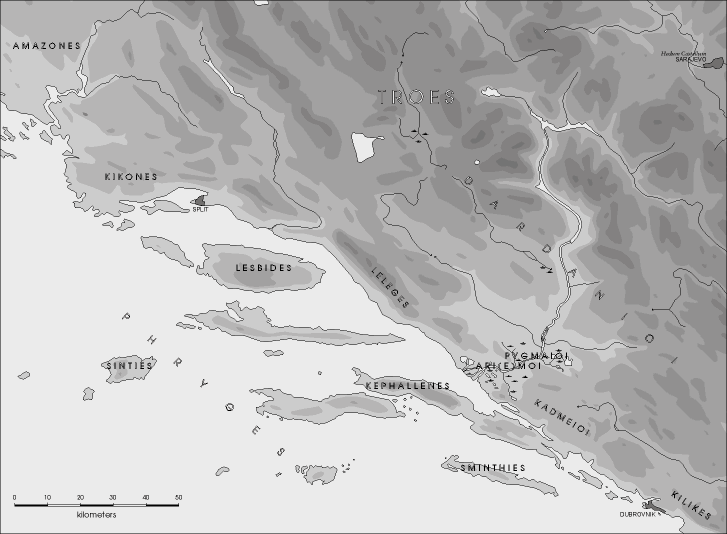
THE ILLYRIAN ETHNOGENESIS
It was from these comings and goings into and out of Troy that, over an extended period
of time—perhaps some three or four centuries—at the time of the Trojan War (near
1200 B.C.), several tribes formed a closely-knit federation under the name of Troes (or
Trojans)—
| ISLANDS |
SEABOARD |
INTERIOR |
|
|
|
|
AMAZONES |
|
|
KIKONES |
|
|
LELEGES |
|
| LESBIDES |
|
|
| SINTIES |
|
ARIMOI
/ PYGMAIOI |
| SMINTHIES |
|
|
|
KADMEIOI |
|
|
KEPHALLENES |
|
|
KILIKES |
|
The Iliad's authorship, it seems, was fully aware of the need of connecting those tribes
which had been known as Trojans with tribes, which, after the Trojan War, would
henceforward be known as Illyrians, and appears to have made a special proviso for such a
connection. Of all the Phrygian tribes, it is only in the names of the Leleges and
Kadmeioi where an idea of a 'fostered progeny' might be detected. In the name of the
Leleges, is the eponymous ancestry of a certain Lelex from the Tyrhennian coast, and in
the name of the Kadmeioi is the eponymous ancestry of Kadmos from the Adriatic's
headwaters.
So it is that, in the wake of the Trojan War, the House of Pelops, under Agamemnon,
finally took the islands of the Adriatic Archipelago which became known as the
'Peloponessos' (a name not until much later transferred to—or taken by—Hellas),
and those formerly called Trojans became Illyrians, who, in later times, were historically
documented as follows—
The Illyrians, properly said, retained an ethnic identity until the Coming of the Slavs in
the 6th and 7th centuries AD. after which, it would be fair to assume, intermarriage
eventually produced those whom, today, call themselves Southern Slavs: Yugoslavians.
(Albeit the entire population of Gabela claims—and rightly so— direct ancestry
from king Priam himself!).
|