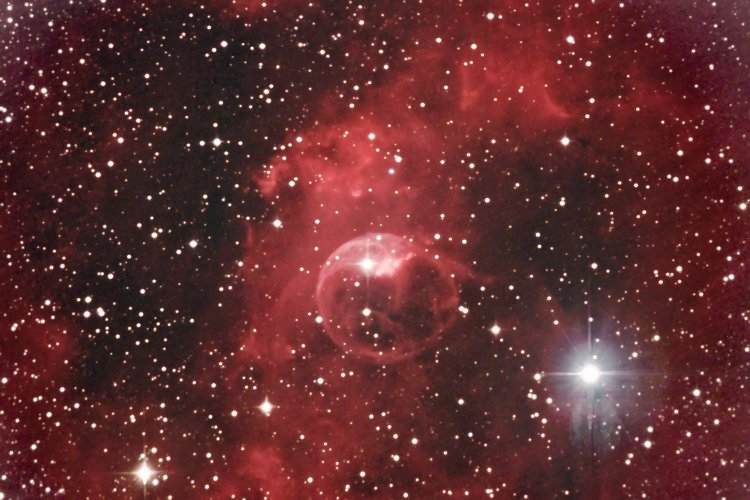
SPHERE-BALL-SFERA-LOPTA-KUGLA-TOPKA-TOPKATA
Research by Rudolf Bosnjak
Different name for same THING - Razlicita imena za istu STVAR
Invisible and transparent shapes in universe. This shapes are VISIBLE ONLY UNDER SPECIFIC VIEWING ANGLE and UNDER SPECIFIC LIGHT REFLECTION WHO PASSING THROUGHOUT SPHERE UNDER SPECIFIC ANGLE.
Very clear visible SPHERE and is named NGC 7635.
The region between the star and ridge reveals several loops and arcs that have never been seen before. The high-resolution capabilities of Hubble make it possible to examine these features in detail in a way that is not possible from the ground.

A lower ridge appears to lie within the sphere of the bubble but is not actually inside the gaseous region. Instead, it is being pushed up against the bubble like a hand being pushed against the outside of a party balloon
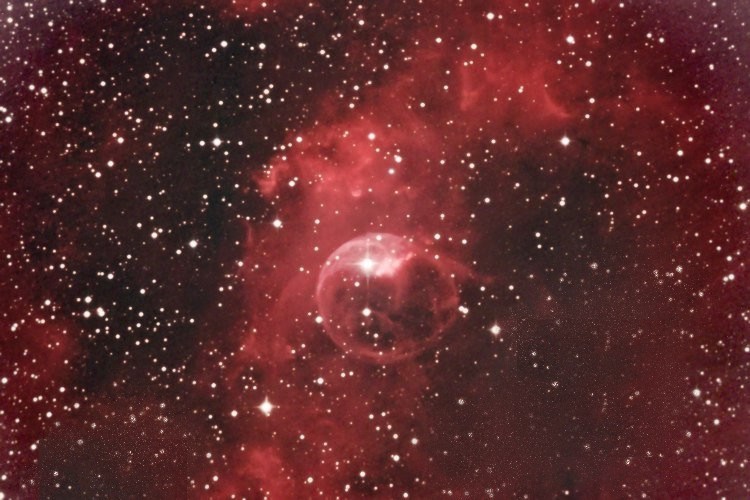
On this image I remove stars from above image for better understanding of this shape.
Hubble catches a cosmic 'bubble'
January 18, 2000 Web posted at: 9:49 AM EST (1449 GMT)
(CNN) -- NASA's Hubble Space Telescope has taken pictures of the Bubble Nebula with
unprecedented clarity, helping astronomers
understand for the first time the geometry and dynamics of the enigmatic system, the Space
Telescope Science Institute said in a statement.
Now read in red color THEIR COMMENTS as:
GUESSING, GUESSING AND MANY GUESSING just
watching the image and all come from astronomers and scientist.
The remarkably spherical "bubble" marks the
boundary between an intense wind of particles from a massive central star and the more
quiescent interior of the nebula, astronomers said.
The star of the nebula has 40 times more mass than the sun
and is responsible for a stellar wind moving at 4 million mph (7 million km/h), which
propels particles off the surface of the star.
The bubble surface actually marks the leading edge of this
wind's gust front, which is slowing as it plows into the denser surrounding material. The
surface of the bubble is not uniform because as the shell expands outward it encounters
regions of the cold gas, which with varying densities slow the
expansion by differing amounts, resulting in the rippled appearance.
It is this gradient of background material that the wind is encountering that places the
central star off center in the bubble. There is more material to the
northeast of the nebula than to the southwest, so that the wind advances less in that
direction, offsetting the central star from the geometric center of the bubble.
The Bubble Nebula is located 7,100 light-years from Earth in
the constellation Cassiopeia. It has a diameter of 6 light-years. Scientists refer to
the nebula as NGC 7635.
The region between the star and ridge reveals several loops and arcs that have never been
seen before. The high-resolution capabilities of Hubble
make it possible to examine these features in detail in a way that is not possible from
the ground.
A lower ridge appears to lie within the sphere of the bubble but is not actually inside
the gaseous region. Instead, it is being pushed up against the
bubble like a hand being pushed against the outside of a party balloon, according to
Hubble astronomers.
As the bubble moves up but not through the ridge, bright blue arcs form where the
supersonic wind strikes the ridge.
THAT IS ONLY TRUTH THEY DID NOT GUESS.
Scientists say the origin of this
"bubble-within-a-bubble" remains unknown. It may be due to a collision of two
distinct winds. The stellar wind may be colliding with material streaming off the ridge.
Copyright © All rights reserved. Rudolf Bosnjak.