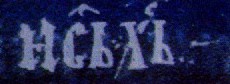
What is TERREhO LI REGIE DNNL at the King Tvrdko seal...
Nanoparticles WAS KNOWN in HVAL Manuscript

Original page is here http://centro-geologia.fc.ul.pt/formacao/d23.htm
PhD thesis in Geology (Hydrogeology). Lisbon University, 28/06/2001. Supervisor: Prof. Manuel Oliveira da Silva.
CONTENT OF SUBJECTS
- INTRODUCTION
- GEOLOGY AND PETROLOGY
- ROCK GEOCHEMISTRY
- MINERAL CHEMISTRY AND GEOBAROMETRY
- CONCLUSIONS
389 pages
This study focuses on the hydrogeological analysis of the hydrological basin of the Fervença River, south of the town of Bragança, comprising the period between 1995 and 1997.
It was important to keep the geomorphologic characterisation within the main features of
the region, thus analysing several interpretations about the evolution that the eastern
region of Trás-os-Montes has been suffering through time. The close observation of the
study area allows us to verify that its morphology is mainly characterised by the great
Bragança basin, surrounded by different hills, in the middle of which two important
streams of water flow, the Fervença and the Penacal River.
Geological conditions have also been analysed from a regional point of view and in this
particular issue the polimetamorphic massif of Bragança does distinguish itself, due to
the great lithological diversity and its both complex and difficult interpretation. In the
last two decades this region has been subjected to a great diversity of interpretations
from the scientific community concerned with its study. The Fervença basin comprises some
of the lands belonging to the massif, where the alien continental and ophiolithical soils
may be found. This particular basin includes local and paralocal soils, which surround the
more interior geological units.
Regarding the climate, the area that has been the object of this study, is influenced by a
Continental kind of climate, with long and cold winters and short and warm summers.
Therefore an explanation can be found for the behaviour of the split aquifers in the
region.
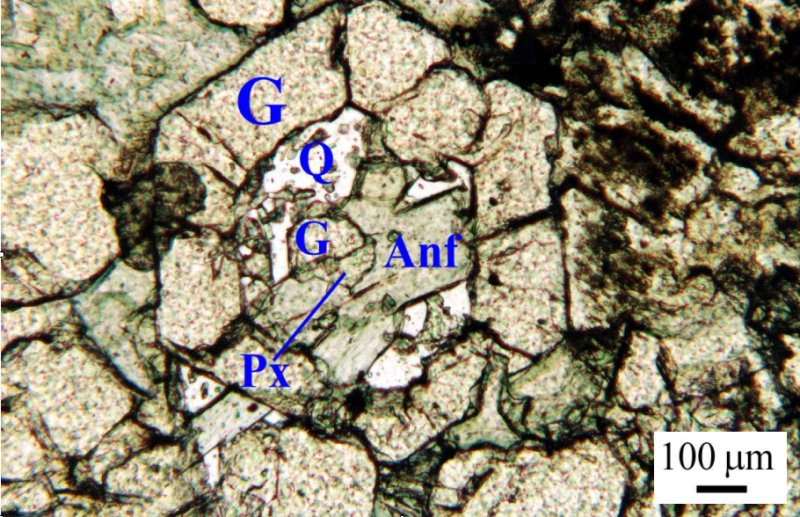
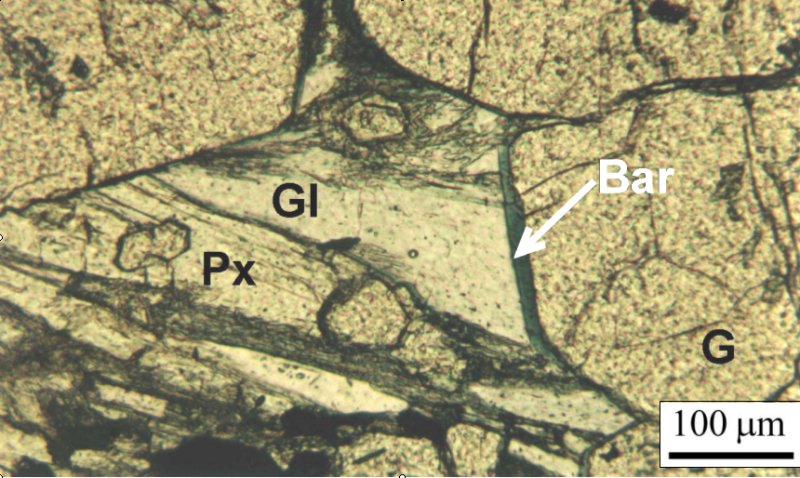
Eclogito (Safira). Anf - anfibola; G - granada; Px - piroxena; Q - quartzo. Nicois paralelos.
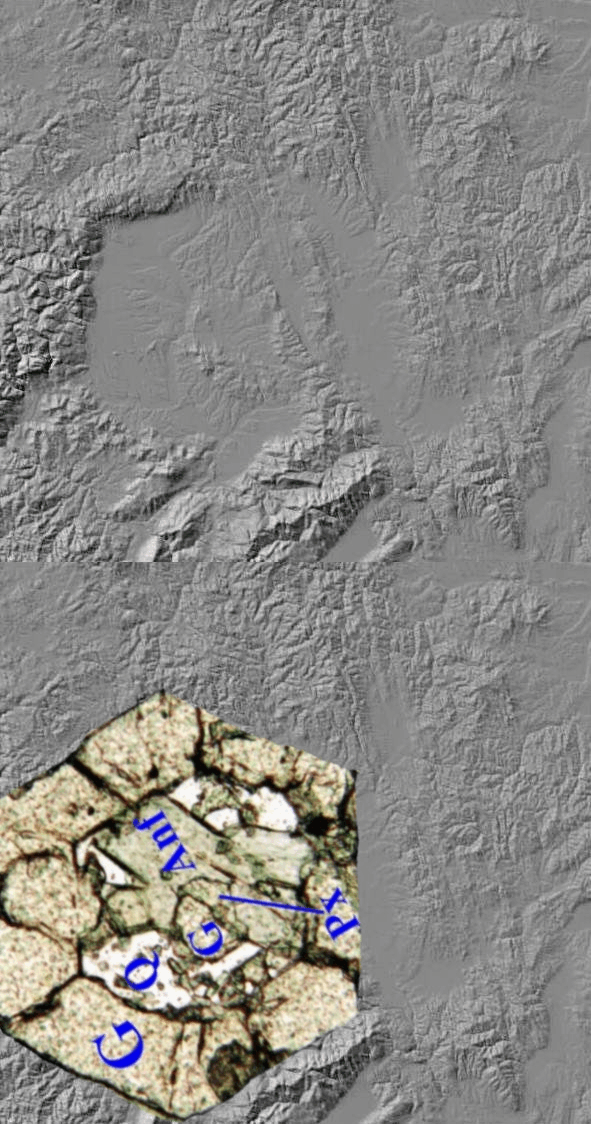
What is connection between paramagnetic molecules and Kosova?
This is animation, sekstagon is embedded in Kosovo shape.
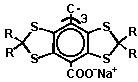
TRITYL


What is connection between paramagnetic molecules and Kosova?
Due to Heisenberg spin exchange with
paramagnetic molecules, spin probes show line width broadening
proportional to oxygen concentration. Trityl, with its unpaired electron located at the
carbon atom of nuclear
spin zero, has a single narrow EPR line(2.5microT) suitable for fine-resolution EPR
imaging.
Original link here http://www.radonc.uchicago.edu/lfepri/projects/oxygen.html
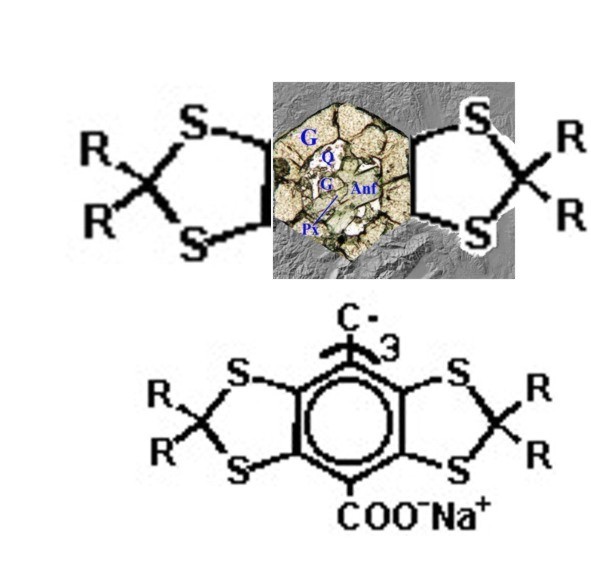
Click here to see Kosovo shape from satellite and as radio propagation chart
What is connection between paramagnetic molecules and Stecak?
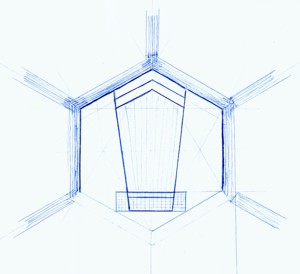
What is connection between paramagnetic molecules and Stecak?
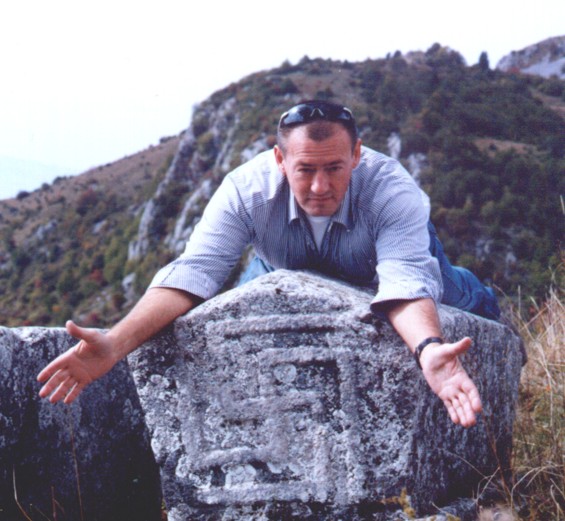
What is connection between paramagnetic molecules and Stecak?
Original page here http://www.eurekalert.org/features/doe/2004-08/dnnl-nmm082404.php
Nanoparticles may mean longer life for enzymes
The biochemical world's workaholic is the enzyme. Enzymes are molecules in cells that lead short, active and brutal lives. They restlessly catalyze their neighbors, cleaving and assembling proteins and metabolizing compounds. After a few hours of furious activity, they are what chemists call "destabilized," or spent.
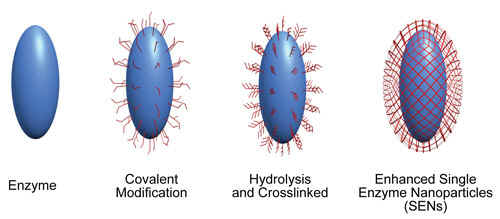
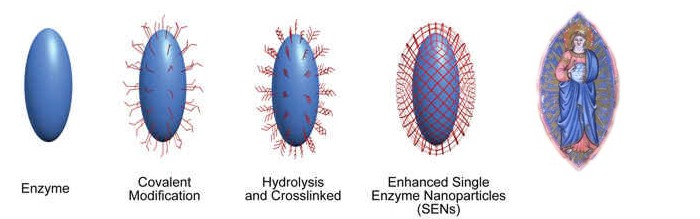
Above is original image
This in different coloure is added from Rudolf Bosnjak Below on right side is added an IMAGE and you can see same ENZYME as was shown in HVAL manuscript, as this was religious view.
Nanoparticles WAS KNOWN in HVAL Manuscript,
but name was WRITTEN in Cyrillic AND NOBODY NOTICE. .
|
This sad fact of nature, said Pacific Northwest National Laboratory Fellow Jay Grate, has limited the possibilities of harnessing enzymes as catalytic tools outside the cell, in uses that range from biosensing to toxic waste cleanup.
But Grate and PNNL Senior Scientist Jungbae Kim have corrected for the enzyme's quick-burn proclivity. Their idea for creating a long-lived and active "Methuselah enzyme" has been to build a barrier between the enzyme and its certain degradation in a harsh environment. The trick, they have found, is to protectively "cage" the enzyme, while leaving the active region--the part that actually does the catalyzing--accessible for chemical reactions of interest.
And it works, as Kim recently reported to the national meeting of the American Chemical Society. They call their caged enzyme SEN, a single-enzyme nanoparticle, where the "cage" is just a few nanometers thick. The SEN's cage is ingeniously synthesized on the surface of the enzyme molecule using organic and inorganic materials that Kim and Grate add to the mix. The organic-inorganic composite protects the catalyst, enabling it to remain active for months instead of hours.
"Converting free enzymes into these novel enzyme-containing nanoparticles can result in significantly more stable catalytic activity," Grate said.
The duo, working in the Environmental Molecular Sciences Laboratory (EMSL), experimented with a common protein-splitting enzyme called alpha-chymotrypsin. To the enzyme's surface they affixed vinyl groups, which formed anchors for an outgrowth of polymer threads from the enzyme. A second polymerization step cross-linked silicate chains, forming a basketball-netlike structure a few nanometers thick.
SENs appear in electron microscopic images as hollow enzyme-containing blobs about eight nanometers across. Kim and Grate found that by using less reactive forms of vinyl they could vary the nano-netting's thickness by half. Thick or thin, the porous netting preserves the enzyme's shape and activity. SENs also are amenable to storage; they have been refrigerated for five months, losing little of their activity.
Among the uses they note for SENs is to break down toxic waste, in which a single treatment could last months. Stabilized enzymes also are a prerequisite for many types of biosensors. And they may be of interest for coating surfaces, with applications ranging from medicine (protecting implants from protein plaques) to shipping (keeping barnacles off hulls). PNNL is investigating several other applications in the environmental and life sciences.
While the PNNL team has thus far caged a single enzyme, Kim said, "The principal concept can be used with many water-soluble enzymes."
Original page here http://www2.eurekalert.org/pub_releases/2004-03/dnnl-anw032904.php
A new way to see DNA (and other tiny molecules)
Pacific Northwest National Laboratory scientists report that they have found their away around an optical-microscope barrier known as the “diffraction limit”—a 200 nanometer cutoff where the too-tiny escapes resolution.
ANAHEIM, Calif.--Like many objects of curiosity in the nanoworld, the DNA molecule has defied visual scrutiny because it lies beyond the "diffraction limit"--a 200 nanometer cutoff where the too-tiny escapes resolution by an optical microscope.
Dehong Hu and Peter Lu, scientists at the Department of Energy's Pacific Northwest National Laboratory in Richland, Wash., report today here at the American Chemical Society's national meeting that they have found their away around this barrier, combining FLIM, or fluorescence lifetime imaging microscopy, with AFM, atomic force microscopy.
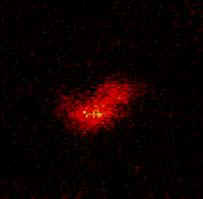
Here, the blurry, pixilated FLIM image, above right, shows a cluster of florescence-tagged DNA molecules about one micrometer long.
A blurry, pixilated FLIM image shows a cluster of florescence-tagged DNA molecules about one micrometer long. When FLIM is combined with an AFM technique that employs a gold-tipped silicon wand that can probe a sample without harming it, the molecule's structure is revealed.
The gold tip, Hu explains, generates a strong electrical field when illuminated by a laser; the electric field's interaction with the fluorescing molecules in the sample provides the image with its contrast.
Hu and Lu have also produced sharp images of fluorescing nanobeads, 40 nanometers diameter.
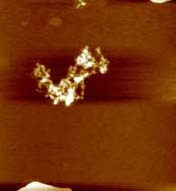
When FLIM is combined with an AFM technique that employs a gold-tipped silicon wand that can probe a sample without harming it, the molecule’s structure is revealed, above.
PNNL is a DOE Office of Science laboratory that solves complex problems in energy, national security, the environment and life sciences by advancing the understanding of physics, chemistry, biology and computation. PNNL employs 3,800, has a $600 million annual budget, and has been managed by Ohio-based Battelle since the lab's inception in 1965.
Prva strana
Tvrdko index Kulin ban index
Kosovo index
Copyright (C) January 2005, All rights reserved. Rudolf Bošnjak.
Prava kopiranja ©. Sva prava pridržana. Rudolf Bošnjak. Bosna i Hercegovina. |
|
| Prava kopiranja ©. Sva prava pridržana. Rudolf Bošnjak. | Copyright ©. All rights reserved. Rudolf (Boschnjak) Bosnjak. |
|
|