
Balkan Museum - Balkanski Muzej
I will
present historical artifact find by myself on different sources
in area of former prehistoric area of Illyricum
and present Balkan countries
Knjiga govori o otkricu i
istraživanju ilirskog svetišta iz vremena helenizma, te donosi prve interpretacije tog
nesvakidašnjeg arheološkog nalazišta. Svetište u Spili kod Nakovane otkriveno je
slucajno, prilikom rutinskih arheoloških istraživanja, u ljetu 1999. godine. Zbog
sigurnosti tog rijetkog i iznimno dobro ocuvanog nalazišta, otkrice je držano u tajnosti
sve do iduce jeseni. U meduvremenu su provedena opsežna arheološka istraživanja koja su
dala neobicno vrijedne i efektne rezultate.
Osim nekoliko vrlo kratkih prethodnih izvještaja u strucnoj literaturi, ova je knjiga
prvi cjeloviti prikaz tijeka i rezultata istraživanja, i to u obliku pristupacnom
širokom citateljstvu. Knjiga je namijenjena svima onima koje zanima drevna prošlost
Jadrana. Ilirsko svetište u Spili cini njenu okosnicu, no pricu o svetištu proširena je
na niz opcenitih tema vezanih uz vrijeme kada je svetište bilo u funkciji, kao i uz
prirodu i svakodnevicu samih arheoloških istraživanja. Tako cilj knjige nije samo
predstaviti javnosti jedno zanimljivo arheološko otkrice, vec i iskoristiti tu priliku da
se na pristupacan nacin docara što je zapravo arheologija i približi davno vrijeme kojem
je svetište pripadalo.
Discovery
and exploration of an Illyrian sanctuary on the Peljesac peninsula
by Staso Forenbaher and Timothy Kaiser

Nakovana Cave: An Illyrian Ritual Site!!!
Peljesac folk tale
And there is a place in Nakovana where treasure is buried.
And they say that this treasure will be discovered if John and Mary go together, and when
the rooster crows at the eleventh hour, they should gather what is before them, and that
will be the treasure.
And they arranged for it once, and they went, but they fell asleep, so that they heard
neither the eleventh hour nor the rooster.
Central Dalmatia

The location of Nakovana Cave on Dalmatia's Peljesac peninsula, showing nearby
Illyrian sites, Greek colonies, and ancient sea-lanes.
Preface
Ever wonder what archaeologists do?
When most people think about archaeologists, the image that most often comes to mind is
that of a heroic or eccentric explorer chancing upon the spectacular remains of a distant
past.
"What do you see?" asked the companion. And from within King Tutankhamen's dark
tomb came the archaeologist's reply, "Wonderful things."
People sometimes think that exciting discoveries about the past, treasures of one kind or
another, lie around every corner just waiting to be unearthed by some archaeologist. Among
children, "archaeologist" is a popular answer to the question, "What do you
want to be when you grow up?" You'd think that the profession would be jam-packed
with enthusiasts.

As it turns out, though, few people ever do become archaeologists. Perhaps that's because
it is not a lucrative occupation, or maybe it is because the reality of archaeology is
quite different from the stereotype. Most of the work in our profession is not terribly
exciting. The romantic image of the archaeologist, who works in some exotic locale under
the benevolent sponsorship of a powerful institution or a rich patron, discovering lost
civilizations and the like, belongs to the past.
These days, the struggle for funds and administrative work take up as much time as
research. Archaeological digs are often found on urban building sites and highway
rights-of-way, conducted under the pressure of deadlines and in the shadow of construction
machinery.

Fieldwork is followed by finds processing and artifact analysis, tasks that involve
endlessly repetitive routine procedures and thousands of hours of sitting in front of a
computer. Years often pass before one is able to say something definitive about what one
has actually excavated, and the results, not spectacular enough to arouse public
attention, will interest only other archaeologists.

However, once in a while someone does get lucky
and makes a discovery that resembles a romantic adventure story. In the summer of 1999,
when we began our exploration of Nakovana Cave, we had no inkling that only a few meters
away lay a hidden chamber of the cave, sealed long ago. Sequestered in this chamber were
rich traces of mysterious rituals, which took place there over two thousand years ago.
In this book we relate how, through a combination of our natural curiosity, a professional
hunch, and, above all, good luck, we discovered and explored an excellently preserved
Illyrian sanctuary from the Hellenistic period, ca. 4th-1st c. BC.
We offer our first interpretations of this extraordinarily rare and valuable site based on
analyses of the archaeological evidence we recovered from the cave. Our exploration of the
cave sanctuary is now finished for the moment, but analyses of finds continue, and
investigations of other archaeological monuments on the Nakovana plateau have only just
begun. We are certain that they will yield new information that will augment, and
sometimes modify, the answers to the questions that we discuss here.
One thing is certain, however -- Nakovana Cave is a small gem of cultural heritage. It
provides us with a unique window into the spiritual world of the Illyrians at a time
immediately before this ancient culture was finally incorporated into the Mediterranean
world of classical antiquity.
The discovery

It's a hot summer afternoon and our small field
crew is going about its routine work, looking for traces of the past. We are digging with
small tools, slowly, carefully removing thin layers of dirt from the bottom of a square
hole that is almost 3 meters deep; it's what archaeologists call a "test
trench."
Only the occasional muffled word, the metallic ring of a trowel scraping against a rock
and the rhythmic rattle of our sieves being shaken, disturb the thunderous chirping of the
crickets. Luckily, the test trench is located just inside the entrance of a cave, so we
are always in the shade, while outside the sun mercilessly bakes the maquis and the rocks.
Our cave, known simply as "Spila" ("Cave") is hidden near the top of a
rocky ridge that extends from the massive summit of Mt. St. Elias towards the westernmost
tip of the Peljesac peninsula.
That day the six of us have unexpected helpers. Tamara and Marko, two school kids from the
nearby village of Loviste have joined us out of curiosity. For weeks they've been
clamoring to see what we are doing up there in that cave. We'd like them to think that
what we're up to is interesting and useful, not just a waste of time and money. That's
what most of the villagers must think when they see us returning from the hills each day
-- hot, dirty and apparently empty-handed. But our team is really in sync and there is not
much that we can give our young helpers to do.
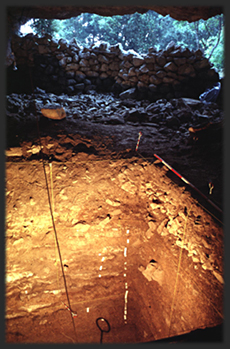
The cave that we are working in is, in fact, a
spacious, low rock shelter. It consists of a single hall that is some fifteen meters wide
at the opening and about as deep. People used to keep goats here, so they barred the
entrance with a dry stone wall, only bits of which are still standing. The ceiling near
the entrance is just high enough for a person to stand upright. It gets progressively
lower towards the back, until it meets the cave floor, which is covered with large rocks.
We keep telling each other that sometime before the end of the season we should see if
there are any interesting archaeological finds hidden in the floor rubble at the back of
the cave. Ancient visitors sometimes lost or left their possessions among the rocks near
cave walls. With the passage of time, pieces of broken pots and discarded tools would slip
between the cracks and stay there, protected from trampling and hidden from souvenir
hunters. To an archaeologist, such ancient trash is a precious source of information.
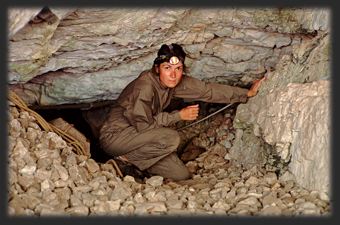
While the rest of us keep digging, Lara decides to keep the teenagers busy by having them
remove some of the stones at the back of the rock shelter. We cannot see what they are
doing from where we are, nearly 3 meters down at the bottom of the trench. We can only
hear dull thumps, the clacking of stone against stone, and snippets of conversation:
"Another potsherd... Bone... No, it's not human; probably it was a sheep or a
goat... Nothing much..."
The afternoon is slowly slipping away just like any other afternoon in the field, until we
hear Lara's voice call out, "Staso, come and look."
Staso doesn't feel like climbing out of the trench unless it's for a very good reason, so
he asks, "What's up?"
"I can't really see," says Lara, "it's dark."
Nakovana Cave: An Illyrian Ritual Site!!!
If you've ever gone spelunking, you'll know that the heart
of a cave explorer beats faster at the mention of darkness beyond. Staso was a caver
before he was ever an archaeologist so he scrambles out of the trench and sees Lara, or,
more precisely, he sees her legs sticking out of a cleft between the stones and the
ceiling.
"So, what does it look like?" he asks.
"It's dark and I can't see a thing. It looks like the rock face is right here, but
then maybe it isn't, maybe one could crawl deeper inside."
"Are you going to take a look?" Staso asks, secretly hoping that the
answer will be no. Sure enough:
"No, you better go yourself if you wish."
Staso takes his headlamp and crawls into the crack Lara has found. His flashlight
illuminates a cleft at least two meters wide and no more than 30 centimeters high. Many
stalactites drip from its ceiling and stalagmites grow from the ground; they frame a space
that looks like the jaws of a shark. The ground slopes off into the darkness.Avoiding the
sharp, brittle stalactites, Staso wriggles downward on his belly.
He does not need to mimic a snake for long. After a few meters, the ceiling begins to
rise, and he can crawl. A little farther and he can stand up.
A cave chamber, some fifteen meters long, opens in front of him. The simple harmony of its
natural architecture catches Staso by surprise. The ceiling consists of a tilted
monolithic limestone slab. One end of the slab rests on a vertical wall three meters high,
completely covered in stalagmitic crust, while the other end reaches to the ground.
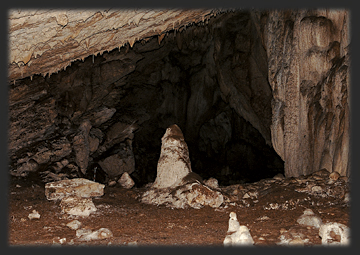
The chamber gets narrower towards the back, and at the far end stands a single, large
stalagmite. A spacious corridor continues behind it, disappearing into the darkness, into
the bowels of the mountain. Stalagmitic formations are clean and intact. The clayey ground
is covered with a thin carbonate crust that crackles with his every step.
Clearly, nobody has been here in a very, very long while.
To discover a new cave channel would in and of itself make any spelunker happy. But, as
Staso sorts out his first impressions, he notices something else that makes him exclaim
loudly with joy, alone in the dark though he is.
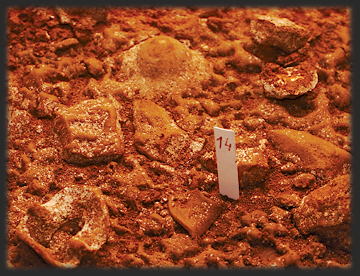
The ground is strewn with many pieces of broken pottery. And not just any pottery! These
are not tiny sherds of coarse, handmade prehistoric pots, a common find in many caves
around here, but rather they are large pieces of fine, thin-walled, elegantly shaped
vessels, decorated with black, red and white paint.
Their style is readily identifiable to any archaeology student: only the ancient Greeks
made such pottery in this corner of the world. A new surprise waits at every step: parts
of a jug, a miniature amphora half-embedded in stalagmitic crust, several almost complete
stemmed cups left in out-of-the-way corners of the chamber. It slowly dawns on Staso that
this is really something quite special, and his initial loud cheerfulness gives way to an
awed silence.
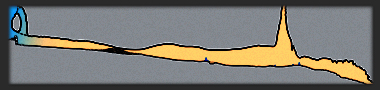
How deep was this cave? Carefully stepping between heaps of vessel fragments, Staso passes
by the lonely stalagmite and enters the dark corridor behind it. Twenty meters beyond, he
reaches a circular-shaped portal. Staso crawls through and lowers himself down a few
natural stone steps into another, smaller chamber richly decorated by variously shaped
stalagmites and stalagmitic curtains. This is the end of the cave, definitely, with no
more holes or cracks to indicate anything beyond.
On his way back, Staso puts a few potsherds in his pocket to show the rest of the crew. By
then Staso has already made up his mind that in order to protect the site for the time
being no one outside the team should know what is hidden in the cave.
The curious faces of our young visitors are waiting for Staso's return. His half-hour long
absence seems suspicious.
"It's tight in there, hard to move about, and there is not too much to see
anyway", he lies shamelessly, faking nonchalance.
Staso doesn't know if they believe him, but they ask no more questions, and he decides
that it is wisest to keep quiet and go back to work in the trench as if nothing has
happened. But the others aren't fooled; they can tell that he is excited.
"What did you find in there?" asks Tim, with a conspiratorial smile.
"Keep digging and don't ask me anything, I'll tell you about it when we get
down," Staso answers in a low voice.
When we return to our base in Loviste, the crew assembles in Staso's room. He reports what
he's seen at the other end of the narrow passage. When he pulls the potsherds out of his
pocket and shows them to Branko, whose specialty is the ancient Greeks in the Adriatic,
Branko's eyes sparkle with delight.

He immediately identifies the pottery: these are sherds of Hellenistic finewares from the
3rd or 4th century BC.
When Staso goes on to tell him that he's brought maybe 5% of what he'd seen scattered
around the chamber, Branko's face breaks into a broad smile. Continued explorations will
soon show that Branko's diagnosis is correct, and Staso's own estimate too modest.
That quiet summer evening, the team gathers around our al fresco dining table near the
water's edge at the end of town. We toast our unexpected discovery, and talk for hours
about what is to be done.
This is what we decide. Part of the crew should continue to work in the test trench, in
part to divert the attention of accidental visitors.
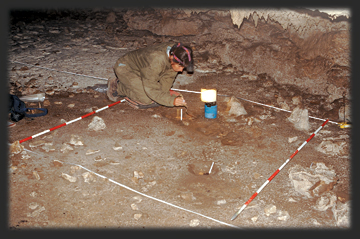
Another, smaller part of the crew should meanwhile systematically collect all surface
finds from the interior chamber.
First, we need to produce a precise ground plan of the newly discovered part of the cave,
and place a 2-meter-square grid over the whole area. This will allow us to map precisely
all surface finds. Information about their spatial distribution will help us greatly when
we try to figure out what was going on in the cave more than two millennia ago.
The following days are spent in drawing the ground plan, staking out the grid, recording
and collecting the potsherds from the surface. Margaret makes a thorough photographic
record of the cave's interior. We pack the finds into labeled plastic bags, and carry them
to the base in Loviste, where they are washed and sorted.
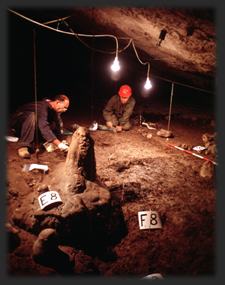
By then we have already noticed that the majority of sherds is concentrated around the
solitary stalagmite. This pillar of rock upstages all else: not only is it in a prominent
position but its shape is unmistakably phallic.
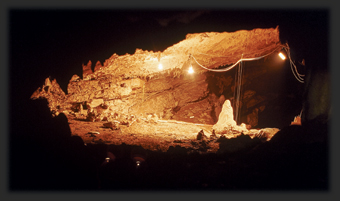
Could it be that we have stumbled across an ancient cult place, where mysterious torch-lit
rituals were held? At first we all give it some silent thought, then joke about it in
disbelief. Numerous indications, to be discussed in detail in the course of the following
chapters, eventually convinced us that indeed we have found a rather special ritual site.
After all the pottery has been cleared from the surface, Tim decides to dig a tiny test
trench beside the stalagmite in order to see what might be hiding below the surface.
Another surprise! Tim's test trench, only 30 x 30 cm and 10 cm deep, yields about two and
a half kilograms of Hellenistic fineware fragments. In other words, unusually fine
archaeological artifacts make up almost a quarter of the mass of the sediment!
We cannot even think about continuing the exploration, since our time and money are
running short. Besides, by now it is clear that we are dealing with an extreme rarity, an
uncommon site - very likely, a sanctuary - which, thanks to lucky circumstances, has
remained undisturbed since it was abandoned over two thousand years ago.
It would be a crime to excavate such a "time capsule" hastily. Careful and
thorough exploration requires ample time and money, as well as appropriate technical
equipment. Besides, we want to include a few more specialists in our work in order to make
it more comprehensive. Therefore, we have no choice other than to re-seal the entrance to
the interior, and hope that Spila will remain unmolested until we can arrange to return.
We spend our last day in the field filling up the entrance to the secret chamber, tossing
in stones to block the cleft. We take care to return the cave to a convincing
approximation of its original appearance. We all agree that the news of our discovery
should be confined to a narrow circle of specialists and friends who can be counted on to
help us organize and carry out the next campaign. We petition the National Heritage
Service of Croatia to register the site as a protected archaeological monument.
The next morning we go our different ways - some of us to the neighboring island of Hvar,
others to Split and Zagreb, still others to far away Canada.
[Over the next three years, we excavated virtually the entire hidden chamber and plumbed
the antiquity of the cave. That part of the story is told in other chapters of the book.]
When and where was the pottery made?
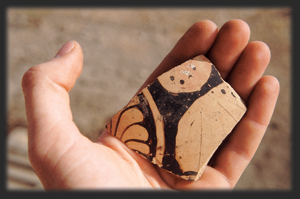
Just as some car afficionados can name a car's make, model and year of manufacture just by
looking at the shape of its lights or fenders, archaeologists can estimate the age of a
ceramic vessel by its shape and decoration, and can sometimes even recognize the workshop
from which it came.
Among the first vessels to be brought to the sanctuary was a cup decorated by spiral
geometric motifs painted in a dark pigment on a light background. The cup was probably
made in one of the market towns that the Greeks founded at the head of the Adriatic, in
the Po River delta. This style, characteristic of the second half of the 4th century BC,
is known as "Alto Adriatico." Another fragment decorated with dark paint on a
light background belongs to the same style and period.
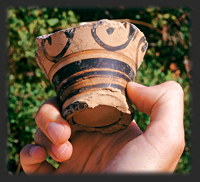
Most of the fine vessels belong to the 3rd century BC. So-called "ribbed
skyphoi" are especially numerous. These pedestalled cups with two horizontal handles
and a glossy black surface decorated with vertical ribs and white- or red-painted designs
were mass-produced in the workshops of Greek colonies in southern Italy. Archaeologists
first discovered this kind of pottery at Gnathia (today Egnazia), a town between Bari and
Brindisi, which is why collectively they are known as "Gnathia ware," although
the main center of their production was in fact the city of Taras (today Taranto). Copies
of Gnathia ware were produced in many other Greek towns, including Issa on the island of
Vis.
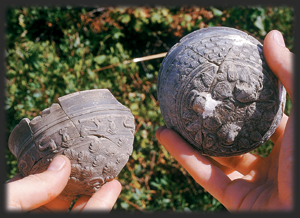
Gray cups with relief decoration, made in moulds, belong to the 2nd or 1st century BC. In
all likelihood, they were made in the Greek colonies of the Dalmatian islands. A mould for
making such cups found at Issa supports this claim.
The vessel that was among the last to be deposited in the sanctuary is a small, coarse jar
with the Latin inscription mentioning Ammartus and Heraclidas. It was probably made
somewhere in Italy, early in the 1st century BC.
From web page http://timkaiser.kaiserworks.com/nakovana.htm
PAŽNJA SVIM KORISNICIMA OVOG MATERIJALA, SVE STO JE NAPISANO I SVI CRTEŽI SU COPYRIGHT
Copyright C 1952-2005. All rights reserved. Rudolf Bosnjak.