| Vladari i GRBOVI Ilira u dalekoj prošlosti... |
ILIRSKA PLEMENA OD KOJIH SVI OVDJE KORIJENE IMAMO
Illyrian Origin
The theory is that the
Albanian language represents a survival of an indigenous Illyrian language.
There is a gap of eight centuries between the last
historical mention of the Illyrians and the first mention of Albanians and of the names
'Albanon' and 'Arbanon' to indicate the region. Supporters of the theory say that the term
'Albanian' gradually came to be applied to the surviving Illyrians.
Arguments for:
- the strongest evidence for the connection between Illyrian and Albanian must be the few direct correspondances of vocabulary often cited {{ref|7}}
- It is claimed by several Albanian scholars that the Komani-Kruja burial sites support the Illyrian-Albanian continuity theory, but other scholars of slavic and non-slavic origin reject this claim and consider that the remains indicate a population of Romanized Illyrians who spoke a Romanic language {{ref|7}}
- there are no records that indicate a migration of Albanians into present day Albania
- Some Illyrian names among Albanians are used, yet it is known that the names were only lately and consciously introduced to emphasize the Illyrian ancestry that is claimed
- According to Dr. S. S. Juka, "Kosova?s toponomy is another indication that the ancestors of the Albanians must have inhabited Dardania." [11]
- Albanoi tribe is mentioned as an Illyrian tribe by the ancient geographer Ptolemy in Book 3 of 'Geographia' around the same area where Albania is in today.
- Ancient terms for cities, rivers and mountains are preserved till this day in Albanian language on those areas populated with Albanians and where the Albanian language is or was spooken before. Many of these terms are Illyrian. (Eqrem ?abej, Illyrian language & Albanian language).
- There is a definite Messapic connection between what is now Albania and southern Italy.
Here follows some examples:
::*Ragusa: Rush
::*Scodra: Shkoder
::*Astibus: Shtip
::*Naissus: Nish (Naissus was in Moesia and is usually considered
Thracian)
::*Scradus mons: Shar
::*Scupi: Shkup (not known to be
Illyrian)
::*Drivastum: Drisht
::*Pirustae: Qafa e Prushit
::*Lissus: Lesh/Lezha (in Latin to Albanian, Lat. ''-is-'' becomes Albanian ''--esh--'')
::*Candavia: Kunavlja
::*Durrachium: Durr?s (lat.
suffix -ium)
::*Isamnus: Ishem
::*Scampinus: Shkumbini
::*Aulon: Vlone/ Vlore
::*Thyamis: Tcham
::*Ulcinium: Ulqin (lat. suffix -ium)
::*Amatia: Mati
::*Stoponion: Shtiponje
::*Tomarus: Tomor
::*Ochrid: Oh?r
::*Phoenice: Foinike, Finiq
::*Drinus: Drini
::*Mathis: Mat
::*Ulpiana (Ulipiana): Lipjan (Ulpiana
is a Roman toponym) and this is present and today name for
city PRISTINE. Image below showing part of ULPIANA, and what is visible is that all is
covered with ground-earth-land few meter tick.
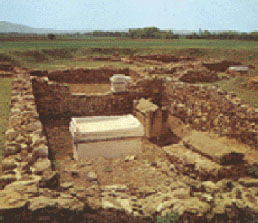
Today Pristine
was built on ruins of ULPIANA.
Image:Bgiusca_Jirecek_Line.jpg|thumb|250px|The
[[Jirecek Line|Jireček Line divides the areas of the Balkans which were under Latin
and Greek influences]]
Arguments against:

- the Albanians were not mentioned in Byzantine chronicles until 1043, although Illyria was part of the Byzantine Empire, and since the Illyrians are referred to for the last time as an ethnic group in Miracula Sancti Demetri (7th century AD.), some scholars maintain that after the arrival of the Slavs the Illyrians were extinct. {{ref|3}}
- (see the Jireček Line) it is believed that most inhabitants of Illyria were Hellenized (the Southern part) and later Romanized (opponents say that some Illyrians were not Hellenized or Romanized, but maintained their own language, which may have been a proto-Albanian language). {{ref|7}}
- most Illyrian toponyms, hydronyms, names, and words have not been shown to be related to Albanian, and they do not indicate that Illyrians spoke a proto-Albanian language (opponents say that many of these toponyms, hydronyms and names are Hellenized and Romanized; weather the change in form is dramatic or not is hard to know).
- ancient Illyrian toponyms (such as Shkoder from the ancient Scodra, Tomor from ancient Tomarus) were not directly inherited in Albanian, as their modern names do not correspond to the phonetic laws of Albanian {{ref|2}}
- a number of scholars believe that Illyrian was a Centum language, though others disagree. If Illyrian was Centum, then it is unlikely that Albanian (which is basically Satem) is an Illyrian language {{ref|3}}
Thracian/Dacian origin
Arguments for:
- Albanian shares several hundred common words with Romanian, believed to be part of the Dacian substrate (see: List of Dacian words), as well as grammatical and phonological features (see: Balkan language union). {{ref|4}}
- Vladimir Georgiev claimed that the phonetics of the Dacian language (based largely on his interpretation of the toponyms) are close to those of Albanian. {{ref|1}}
- names of the cities that follow Albanian phonetic laws (which include Shtip, Shkupi and Nish) are in the areas once inhabited by Thracians, Dardani, and Paionians. {{ref|8}}
- There are some correspondances between Thracian and Albanian words, but few in comparison to the body of material. {{ref|3}}
Arguments against:
- many Dacians and Thracian placenames were made out of joined names (such as "Sucidava" or "Bessapara"), while Albanian language does not allow this. {{ref|3}}
- there are no records that indicate a migration of Dacians into present day Albania. {{ref|3}}
- from the extensive body of Thracian and Dacian words, names, and language-elements, only a very small number of them have been linked to Albanian; the great majority of Daco-Thracian words and names do not have Albanian correspondances. {{ref|3}} {{ref|4}}
- the common non-Romance words between Albanian and Romanian may possibly be explained by another scenario, and some of these common words may have been words that were exchanged between proto-Albanians and Dacians and Thracians in ancient times, the exchange going both ways, however, this would not explain the common Romance words and expressions. {{ref|3}} {{ref|4}}
- the closeness in phonetics between Dacian and Albanian that Vladimir Georgiev claimed is not accepted by a large number of linguists; it has been challenged and even possibly disproven, and is based on fragmentary evidence. {{ref|3}}
- the Balkan language union may date back to Neolithic times, so what phonetic similarities may have existed between Dacian and Albanian could be explained by linguistic interactions over the centuries. {{ref|6}}
- It is clear from linguistic analysis that the proto-Albanian language and the language of the Romanian substratum were already no longer one language (if they ever were) before the Roman conquest of Dacia; so the proto-Albanian speakers and the speakers of Romanian's substratum language most likely were not both living in the same area (Dacia, etc.) at the time of the Roman conquest.
Pelasgian/Etruscan origin
The Pelasgians
are generally considered to be the people that were living in the Balkans before the
Indo-European arrival, the Greek writers mentioning them as autochthonic peoples that
predated hellenic settlement. The Etruscans were also indigenous people
of Europe, but it is not known whether they were or not related to the Pelasgians.
The Communist regime of Albania embraced the ideology that the Albanians were descendants
of the Etruscans (based on the books of French scholar Zacharia Mayani) and used this for
propaganda, discarding the fact proven scientifically that Albanian is an Indo-European
language (having known kins would make Albanians less unique).
Mainstream linguists and historians never seriously considered the idea of Albanians
having an Etruscan origin, because the proponents of the Etruscan-theory were not using a
scientific method, but were using pure linguistic coincidences.
Caucasus origin
In ancient times, there was another region called "Albania", in the Caucasus, bordering the Caspian Sea. However, that name was simply a coincidence, "alb" being a common Indo-European word meaning "white" or "mountain" with many toponyms deriving from it, including the Alps and Alba, the Gaelic name of Scotland.
Illyria
{{otheruses}}
In classical history, '''Illyria''' or '''Illyricum''' or '''Illyrikon''' was a region of
the western Balkan Peninsula
inhabited by the tribes and clans of '''Illyrians''', an ancient people who probably spoke
an Indo-European language the
Illyrian languages.
Illyrian languages
The '''Illyrian languages''' are a group of Indo-European languages
that were spoken in the western part of the Balkans in pre-Roman times. Around 230 BC the speakers of these languages
were romanized (in some cases
completely, as in the case of Dalmatian
speakers).
From the 7th century onwards, the
surviving Illyrian languages began to lose ground to other languages spoken in the area,
largely Slavic languages in
the rural areas and the languages descended from vernacular Latin such as Dalmatian and Venetian in the urban areas.
Today, the main source of authoritative information about the Illyrian languages consists
of a few cited words and numerous examples of proper names, toponyms, and hydronyms. Since
so little is known about these languages, when linguists encounter what they consider to
be anomalies in their data, they humorously blame them on "Illyrian influences".
Messapian, an extinct
language of South-eastern Italy, is believed by most scholars to be a dialect of Illyrian,
based on the personal names found on the tomb inscriptions, and based also on classical
references which state explicitly that the Messapians migrated by sea to Southern Italy,
having originally come from Illyria. Some scholars decline to identify Messapian
specifically as an Illyrian language; yet most scholars consider that the languages were
closely related.
Illyrian may also have been related to the Venetic language once spoken in
Northeastern Italy, though the theory
that Illyrian and Venetic were closely related is no longer favored by current
scholarship.
Some linguists believe the modern Albanian language to be the
survival of an Illyrian language, yet this is controversial. The majority of scholars and
linguists consider Illyrian to have been a centum
language, while Albanian is satem. The
identification of Illyrian as centum is not unanimously accepted; objections being raised
by those linguists who attempt to link Albanian with Illyrian. In general, Illyrian words
from ancient sources suggest that Albanian and Illyrian are on different branches of the
Indo-European langauge-tree, though there are some possible correspondances between
Illyrian and Albanian.
Some examples of Illyrian names are ''Epicadus, Bato, Gentius, Temus, Pinnes/Pinnius,
Monounios, Grabus, Epidius, Verzo, Zanatis.''
See also
External link
- [http://www.geocities.com/indoeurop/project/glossary/illy.html Illyrian glossary]
Category:Extinct
languages
Category:Indo-European
languages
Category:Illyria
als:Illyrische Sprache
az:Paleobalkan qrupu
de:Illyrische Sprache
nl:Illyrisch
pl:Język iliryjski
ro:Limbile ilirice
The main cities of Illyria were Lissus
and (probably) Epidamnus. The
Illyrians may have appeared in the western part of the Balkan Peninsula about 2000 BC, a period coinciding with the
end of the Bronze Age and
beginning of the Iron Age. The
Illyrians were not a unified body but a conglomerate of many different tribes. These
tribes however had a common language and culture. The people were unified by the King
Hyllus who is reportedly to have died around the year 1235 B.C. Some believe that this was
the first sign of unified Illyrian kingdom. For at least the next millennium, they
occupied lands extending from the Danube,
Sava, and Morava rivers to the Adriatic Sea and the Šar Mountains.
{{histalbania}}
Some believe that the modern Albanians
are in large part descended from the Illyrians.
An Illyrian tribe of "mountain folk" called the Arber, or Arberesh?, and later
Albanoi, lived near Durr?s.
Origin of Albanians
The '''origin of Albanians''' has been for some time a
matter of dispute among historians. Albanians are people who speak Albanian, an Indo-European language
that has no other close living relative, making it dificult to determine from what ancient
Balkan language it evolved.
Place of origin
The place where Albanian was formed is also disputed, but
by studying the language we can learn that Albanian was formed in a mountainous region
rather than plain or seacoast: while the words for plants and animals that are
characteristic of the mountainous regions are entirely original, the names for sea-fishes
and those for agricultural activities, (such as ploughing) are borrowed from other
languages.
We can also be sure that the Albanians didn't live in Dalmatia, because the Latin influence
over Albanian is of Balkan Romance (that evolved into Romanian) origin rather than of Dalmatian origin. This Balkan
Romance influence includes Latin words exhibiting idiomatic expressions and meaning
changes that are only found in Romanian and not in other Romance languages. Adding this
to the words common only to Albanian and Romanian, we can assume that the Romanians and
Albanians once lived closely. Generally the areas where this might have happened are
considered to be regions varying from Transylvania, Eastern Serbia (region around Naissus/Nis), Kosovo and Northern Albania/Macedonia.
However, Romanian has most agricultural terms of Latin origin, but not terms related to
city activities, showing that Romanians, as opposed to Albanians (who were originally
shepherds), were agricultural people in the low-plains.
Some scholars even explain the gap between Bulgarian and Serbian languages by an
Albanian-Romanian buffer-zone east of the Morava river. (although an
intermediary Serbian dialect exists, it was formed only later after the Serbian expansion
to the east)
Another argument that sustains a northern origin of Albanians is the relative small number
of words of Greek origin, although Southern Illyria was under the influence of
Greek/Byzantine civilization and language, especially after the break-down of the Roman
Empire.
Earliest mentions of Albanians in Albania
- In the II Century BC, the geographer and astronomer from Alexandria, Ptolemy drafted a map of remarkable significance for the history of Illyria. This map shows the city of Albanopolisi (located south of Durr?s), from which the Albanians were later on to be identified by the world.
- The first mention of Albanians in the region corresponding to modern Albania is as the Arbanites of Arbanon in Anna Commenas account of the troubles in that region caused in the reign of her father Alexius I Comneus (1081- 1118) by the Normans. (''The Alexiad, 4'')
The Alexiad
The '''Alexiad''' is a book written around the year 1148 by the Byzantine historian Anna Comnena, the daughter of
Emperor Alexius I.
She describe the political and military history Byzantine Empire during the
reign of her father (1081-1118), making it one of the most important sources of
information on the Byzantines of the Middle Ages.
External links
- [http://www.fordham.edu/halsall/basis/AnnaComnena-Alexiad.html Medieval Sourcebook: Alexiad - complete text, translated Elizabeth A. Dawes]
- In 'History' written in 1079-1080, Byzantine historian Michael Attaliates was first to refer to the "Albanoi" as having taken part in a revolt against Constantinople in 1043 and to the Arbanitai as subjects of the duke of Dyrrachium.
- 1285 in Dubrovnik (Ragusa) where a sizeable Albanian community had existed for some time. In the investigation of a robbery in the house of Petro del Volcio of Belena (now Prati), a certain Matthew, son of Mark of Man?e, who appears to have been witness to the crime, states: "Audivi unam vocem clamantem in monte in lingua albanesca" (I heard a voice crying in the mountains in the Albanian language).
Ethnic origin
The two chief candidates considered by historians are Illyrian or Thracian, though there were
other groups in the ancient Balkans that were neither Illyrian nor Thracian, including Paionians (who lived north of Macedon), Agrianes, Laeaeans, Odomantians, Siropaeonians, and Paeoplians. The Illyrian language and
the Thracian language are generally considered to have been on different Indo-European
branches. Not much is left of the old Illyrian or Thracian tongues, making it difficult to
match Albanian with any of them.
There is debate whether the Illyrian language was Centum or Satem, and there is no conclusive evidence
yet either way, though what evidence there is strongly indicates that Illyrian was centum.
It is also uncertain whether the Illyrians spoke a homogenous language or rather a
collection of dialects or even different languages that were wrongly considered the same
language by ancient writers. The same is sometimes said of the Thracian language. For
example, based on the toponyms, it has been argued that Thracian and Dacian may be different
languages or dialects.
In the early half of the 20th century, many scholars thought that Thracian and Illyrian
were one language, but due to the lack of evidence, most linguists are skeptical and now
reject this idea, and usually place them on different branches. The Messapian language is often
considered to have been an Illyrian language, but this is disputed by some.
See also
References
- {{note|1}} Duridanov, Ivan. [http://members.tripod.com/~Groznijat/thrac/thrac_9.html "The Language of the Thracians"], (''Ezikyt na trakite''), Nauka i izkustvo, Sofia, 1976
- {{note|2}} Georgiev, Vladimir. [http://members.tripod.com/~Groznijat/vg/vg.html "Genesis of the Balkan People"], The Slavonic and East European Review 44, no. 103, 1960, p. 285-297
- {{note|3}} Malcolm, Noel. [http://vmro.150m.com/en/nm/kosovo.html "Kosovo, a short history"], Macmilan, London, 1998, p. 22-40
- {{note|4}} Eric P. Hamp, University of Chigaco [http://members.tripod.com/~Groznijat/balkan/ehamp.html The Position of Albanian] (Ancient IE dialects, Proceedings of the Conference on IE linguistics held at the University of California, Los Angeles, April 25-27, 1963, ed. By Henrik Birnbaum and Jaan Puhvel)
- {{note|5}} Rosetti, Alexandru. "History of the Romanian language" (''Istoria limbii rom?ne''), 2 vols., Bucharest, 1965-1969.
- {{note|6}} Alinei, Mario. [http://www.continuitas.com/interdisciplinary.pdf "Balkan sprachbund may date back to Neolithic times"], May 2003.
- {{note|7}} Wilkes, John. "The Illyrians", Oxford, 1992.
- {{note|8}} Jirecek, Konstantin. "The history of the Serbians" (''Geschichte der Serben''), Gotha, 1911
- {{note|9}} Cabej, Eqrem "''Die aelteren Wohnsitze der Albaner auf der Balkanhalbinsel im Lichte der Sprache und Ortsnamen''", Florence, 1961
- {{note|10}} G. Weigand, "Sind die Albaner die Nachkommen der Illyrier oder der Thraker"
- {{note|11}} By Dr. S.S. Juka [http://www.home.no/dukagjin/Footnotes.html Kosova: The Albanians in Yugoslavia in light of historical documents]
Characteristics
In the 19th and early 20th century, archaeologists
associated the Illyrians with the Hallstatt culture, an Iron Age
people noted for production of iron and bronze swords with winged-shaped handles (Ha C)
and for horse breeding. Nowadays, the equation of material culture with linguistic and
political groups is seen as problematic, as neither the rate of culture change nor of
linguistic change is well known.
The area had initially been settled by two groups that would later be known as the Pannonians and the Dalmatians in Roman Empire times, but modern
ideologies of racial nationalism tend to minimize the amount of tribal mixing that has
taken place over the last three millennia.
The Illyrians carried on commerce and warfare with their neighbors. The ancient Macedonians may have had an Illyrian
(as well as Thracian) element, but
under Philip of Macedon
their ruling class adopted Greek
cultural characteristics. The Illyrians also mingled with the Thracians in adjoining lands on the
east. In the south and along the Adriatic
coast, the Illyrians were heavily influenced by the Greeks, who founded trading colonies there. The
present-day city of Durr?s evolved from a Greek colony known as Epidamnos, which was
founded at the end of the 7th
century BC Another famous Greek colony, Apollonia, arose between Durr?s and
the port city of Vlor?.
The Illyrians produced and traded cattle, horses, agricultural goods, and wares fashioned
from locally-mined copper and iron. Feuds and warfare were constant facts of life for the
Illyrian tribes, and Illyrian pirates plagued shipping on the Adriatic Sea. Councils of
elders chose the chieftains who headed each of the numerous Illyrian tribes.
From time to time, local chieftains extended their rule over other tribes and formed
short-lived kingdoms. During the 5th
century BC, a well-developed Illyrian population center existed as far north as the
upper Sava River valley in what is now Slovenia.
Illyrian friezes discovered near the present-day Slovenian city of Ljubljana depict ritual sacrifices,
feasts, battles, sporting events, and other activities.
At various times, groups of Illyrians migrated over land and sea into Italy.
Illyrian kingdom
The Illyrian kingdom of Bardhyllus became a formidable local
power in the 4th century BC.
In 359 BC, King Perdiccas III of Macedonia was killed by attacking
Illyrians. In 358 BC, however,
Macedonia's Philip II,
the father of Alexander the
Great, defeated the Illyrians and assumed control of their territory as far as Lake Ohrid. Alexander himself routed
the forces of the Illyrian chieftain Clitus
in 335 BC, and Illyrian tribal leaders
and soldiers accompanied Alexander on his conquest of Persia. After Alexander's death in 323 BC, independent Illyrian kingdoms
again arose. In 312 BC, King Glaukius expelled the Greeks
from Durr?s. By the end of the third
century, an Illyrian kingdom based near what is now the Albanian city of Shkod?r controlled parts of northern
Albania, Montenegro, and Herzegovina. Under Queen Teuta, Illyrians attacked
Roman merchant vessels plying the Adriatic Sea and gave Rome an excuse to invade the
Balkans.
In the Illyrian Wars of 229 BC and 219 BC, Rome overran the Illyrian
settlements in the Neretva river
valley and suppressed the piracy that had made the Adriatic unsafe. In 180 BC the
Dalmatians declared themselves independent of the Illyrian king Gentius, who kept his capital
at Skodra (Shkoder). The Romans made
new gains in 168 BC, and Roman forces
captured Gentius at Shkoder, which they called ''Scodra'', and brought him to Rome in 165 BC. A century later, Julius Caesar and his rival Pompey fought their decisive battle near
Durr?s (Dyrrachium). Rome finally subjugated recalcitrant Illyrian tribes in the western
Balkans during the reign of Emperor Tiberius
in 9 AD, and established the province of Illyricum, governed by an Imperial
legate. The Romans divided the lands that make up present-day Albania among the provinces
of Macedonia, Dalmatia, and Epirus.
Roman province of Illyricum
For about four centuries, Roman rule brought the
Illyrian-populated lands economic and cultural advancement and ended most of the
enervating clashes among local tribes. The Illyrian mountain clansmen retained local
authority but pledged allegiance to the emperor and acknowledged the authority of his
envoys. During a yearly holiday honoring the Caesars, the Illyrian mountaineers swore
loyalty to the emperor and reaffirmed their political rights. A form of this tradition,
known as the kuvend, has survived to
the present day in northern Albania.
The Romans established numerous military camps and colonies but complete latinization was
confined to the coastal cities. They also oversaw the construction of aqueducts and roads,
including the Via Egnatia, a
famous military highway and trade route that led from Durres through the Shkumbini River valley to
Macedonia and Byzantium (later Constantinople).
Copper, asphalt, and silver were extracted from the mountains.
The main exports were wine, cheese, oil, and fish from Shkod?r Lake and Lake Ohrid.
Imports included tools, metalware, luxury goods, and other manufactured articles.
Apollonia became a cultural center, and Julius Caesar himself sent his nephew, later the
Emperor Augustus, to study
there.
Several of the Roman emperors had their origin in the Romanized population of Illyria.
They included Diocletian (284-305) who saved the empire from
disintegration by introducing institutional reforms, Constantine the Great (324-337) who accepted Christianity and transferred the
empire's capital from Rome to Byzantium,
which he called Constantinople
and Justinian (527-565) -- who codified Roman law, built the most famous
Byzantine church, the Hagia Sophia,
and reextended the empire's control over lost territories.
Illyrians distinguished themselves as warriors in the Roman legions and made up a
significant portion of the Jovians
and Herculians imperial guard of the Roman
Emperors, from their assignment to the task in 284 by Diocletian, when they replaced the Praetorian Guard, until 988 when they were replaced by the Varangian Guard of the Byzantine Empire.
Religion
Christianity came to the Illyrian-populated lands in the 1st century Saint Paul wrote that he preached in
the Roman province of Illyricum, and legend holds that he visited Durr?s. When the Roman
Empire was divided into eastern and western halves in 395, the lands that now make up Albania were
administered by the Eastern Empire but were ecclesiastically dependent on Rome.
However in 732 a Byzantine emperor, Leo the Isaurian, subordinated
the area to the patriarchate of Constantinople. For centuries thereafter, the Albanian
lands became an arena for the ecclesiastical struggle between Rome and Constantinople.
Most Gheg Albanians living above the Shkumbini River which includes today's Tirana, the
Capital of Albania, Shkodra, the fertile lands by the Adriatic Sea and the lake of
Shkodra, and the especially prosperous fields of Kosovo and Tetovo became Roman Catholic, while the Tosk
Albanians living across the Mountenous Eastern South and the Boggy Southwest regions,
below Shkumbini River, joined the Orthodox church.
Legacy
The name "Illyria" went out of use after the
division of the Roman empire under Diocletian.
It was revived by Napoleon for the 'Provinces of Illyria' that
were incorporated into the French
Empire from 1809 to 1813, and the 'Kingdom of Illyria' was part
of Austria until 1849, after which time it was not used in
the reorganised Austro-Hungarian
Empire.
The name ''Illyrians'' was used by some groups among the Croats up to their period of romantic nationalism in the
19th century, but was eventually
abandoned as a potentially misleading anachronism.
In drama and literature Illyria can be a half-fictional country, e.g., in William Shakespeare's ''Twelfth Night'', Jean-Paul Sartre's ''Les Mains Sales'' and in Lloyd Alexander's ''The Illyrian
Adventure'' ISBN 0141303131.
Today, there are Albanian personal names which are obviously part of Illyrian legacy such
as masculine names: "Ilir", "Arber", "Dardan",
"Agron" as well as feminine names like "Teuta".
Illyrian tribes
- Abri
- Alban
- Amantini
- Andizetes
- Arb?r
- Ardiaei
- Ardian
- Arrianes
- Atintani (Atintanes)
- Autariates (Autariate)
- Azali
- Breuci
- Bylliones
- Carni
- Catari
- Celegeri
- Chelidones
- Colapiani (Colapani)
- Cornacates
- Daesitiates
- Dalmat
- Daorsi
- Dardani (actually, a Thraco-Illyrian mix)
- Dasaret (Dassarstae, Dassarenses, Dassaretae)
- Daversi
- Delmatae (Delmetae)
- Deraemestae
- Deuri
- Dindari
- Ditiones
- Docleatae
- Encheleae (Enchelleae)
- Enkelejt
- Eordej
- Epiriot
- Eravisci
- Glintidiones
- Grabaei
- Histri
- Iapydes, Iapodes, Japod
- Iasi (Jasi)
- Japyg
- Kaon
- Labeat (Labeatae, Labeates)
- Latobici
- Lopsi
- Maezaei
- Meslcumani
- Mesap
- Mollos (Mollosi, Molossii)
- Naransii
- Oseriates (Osseriates)
- Parthin (Parthini)
- Penest
- Perestae (Penestae)
- Pirustae (Pirust, Pipustae)
- Plearaei
- Sardeaties
- Scirtari
- Seleiitani
- Siculotae
- Soirtones
- Taulant (Taullani)
- Thesprot
- Vardaei
See also
Reference
- ''[http://lcweb2.loc.gov/frd/cs/altoc.html Library of Congress Country Study] of Albania.''
External links
- [http://linguistlist.org/sp/LangAnalysis.html Eastern Michigan University Wayne State University Linguist list]
Category:Illyria
de:Illyrien
eo:Ilirio
fa:???????
fr:Illyrie
it:Illiria
sv:Illyrien
All rights reserved. Copyrights by Rudolf Bošnjak