Balkan Museum - Balkanski Muzej
I will
present historical artifact find by myself on different sources
in area of former prethistoric area of Illyricum
and present Balkan countries
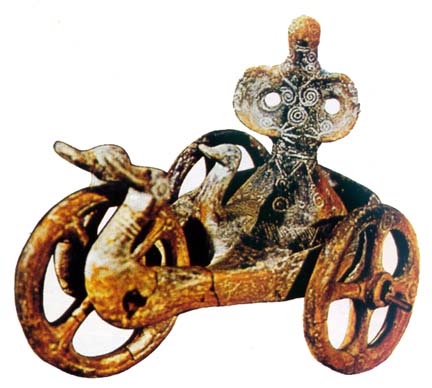
Historical and archeological data: A Votive Carriage from Dupljaja, near Vrsac, Yugoslavia, 1500-1200 years B.C.
It is notable that the 'swan' image is connected with the chariot of the sun as depicted in northern bronze age (See the Dupljaja clay model chariot and notes below):
After Fig. 54. The Dupljaja model in: Peter Gelling and Hilda Ellis Davidson, 1967, The Chariot of the Sun and other rites and symbols of the northern bronze age, New York, Frederick A. Praeger. pp. 119-121: "It is of more than casual interest to establish that there was a close identiy between the two forms of sun-worship. Central Europe was very much less remote from the literate civilizations of the Mediterranean, in particular from that of Greece, and Sprockhoff has shown in a brilliant paper that the possibility exists of actual religious contacts between the two regions (Sprockhoff, 1954, pp. 28 ff.). The vital link is a clay model found at Dupljaja in Yugoslavia (Fig. 54). It consists of a kind of chariot, with a bird perched on its front, drawn by two larger birds whose bodies merge back into it. The floor of the chariot is marked with a sun symbol, on top of which stands a male figure in a long robe who must be regarded as an anthropomorphic representation of the sun. The model is essentially the exact equivalent of the Trundholm chariot, with birds taking the place of the horse, and a human figure replacing the upright disk. If we look southwards to Greece we find in Apollo a god who resembles the Dupljaja figure in that he also was carried across the sky by swans. The classical expression of this belief is in a hymn by Alcaeus, who was writing in the early sixth century BC. The work is unfortunately lost, but the gist of it is known from a paraphrase by Himerius, a Greek rhetorician of the fourth century A.D. When Apollo was born, Zeus gave him a golden headband, a lyre and a chariot -- 'and swans were 'the chariot' -- intending that he should fly to Delphi. Instead he flew to the land of the Hyperboreans, and stayed there for a year. The phrase 'swans were the chariot' describes most admirably the Dupljaja model: they did not simply draw the chariot -- they constituted it. The resemblance is reinforced by Apollo's connection with the Hyperboreans, which is best expressed in a story told by Herodotus (bk iv, c.33). He says that the Hyperboreans were in the habit of sending sacred objects to Delos, Apollo's island, and we are to assume that they still them in his day...The most interesting point is that the earliest part of the journey was towards the west. Believing as they did that the word Hyperborean meant 'beyond the north wind', it is hard to see why the Greeks included a westerly stage in the journey if the story was pure fabrication. In fact it fits very well with a place of origin in the middle Danubian region, which was one of the most vital areas of the Urnfield culture. The Bronze Age amber route had followed the Adriatic, and to reach the sea from the Hungarian stretch of the Danube it is necessary to travel approximately westwords...Apollo, as we know him in Greek tradition, has a complex, slightly foreign, character, and as he has strong connections with the east which cannot possibly be reconciled with his northern contacts, we are oblied to recognize that he is a composite divinity. One strain in his ancestry must have come from central Europe, from the region which worshipped the sun in association with a bird; so theoretically it ought to be possible to deduce something from his cult about central European sun-worship. In practice this turns out to be extremely difficult, if not impossible, for the classical Apollo has little or nothing to do with the sun. He was essentially the embodiment of the ideal (seldom realized) discipline of Hellenic life, one aspect of which, law-giving, was especially under his patronage. His identification with the sun-god appears to be late and artificial..."
http://www.hindunet.org/saraswati/ratha1.htm
PAŽNJA SVIM KORISNICIMA OVOG MATERIJALA, SVE STO JE NAPISANO I SVI CRTEŽI SU COPYRIGHT
Copyright C 1952-2005. All rights reserved. Rudolf Bosnjak.