| U.S. Military
Encirclement of Iran By Judy Bello Sunday,
November 20, 2011, 1:14pm
Iran is, and has been for many years, surrounded by US Military installations. We talk about the U.S.
strategy to encircle China, but you rarely hear about the way in which Iran is, and has
been encircled by U.S. military bases for many years.
When
they you hear that Iran is a threat to the United States, you picture a us, here in the U.S. as potential victims.
When you hear the term ‘containment’ in
relation to Iran, you think, perhaps, that something needs to be
done. After all, we have bases and military trainers and other
military representatives in dangerous countries like Pakistan,
Afghanistan and Iraq. But wait, if those countries
have bases, isn’t Iran pretty well contained?
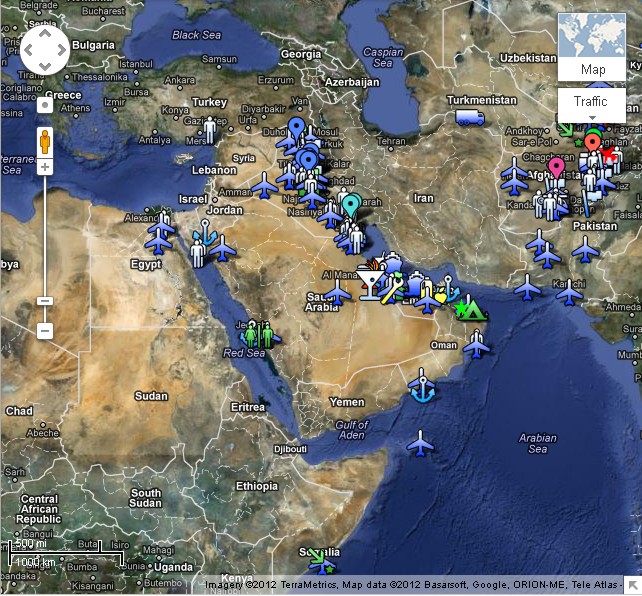
Here is a map of Iran, showing the surrounding U,S. bases
around 2008. Click on the image below to open a dynamic version of the map,
where you can zoom in for a better look, and a key to the various symbols and the names of
the bases. Base names and locations from GlobalSecurity.org.
If you zoom in really close on most of the air bases, you can see the runway.
Now, a new military initiative is rapidly being deployed
across the Middle East, Southwest Asia and Africa, around the world, and even here on the U.S. mainland. New bases are being built and old ones
converted to host Unmanned Ariel Vehicles (UAV); recently
re-designated as Remote Piloted Aircraft (RPA); commonly
referred to as Drones. The largest and most used in the region at this time are
named Predator and Reaper. The MQ9 Reaper can carry
several Hellfire Missiles and laser guided 500 lb. bombs. These Drones fly so high
that they can virtually hover over a target for hours, piloted by a computer operator from
his office or home here in the U.S,. Unfortunately, misinterpretation of
evidence based on cultural discrepancies, pilot impatience, inaccurate target
identification before the Drone is called and other similar issues make civilian
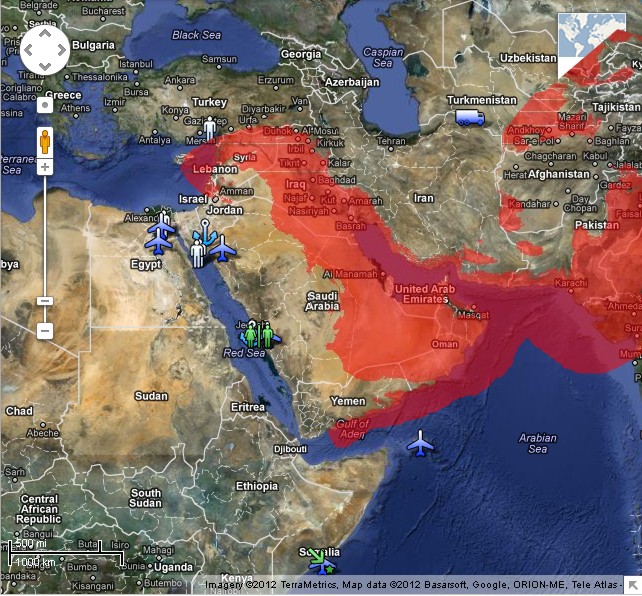
casualties in the context of Drone strikes a regular occurrence. The image below
shows some of the sites known to be used for drone bases.
When I introduce people to the use of these vehicles (I’m
going to call them Drones) in Afghanistan, I often point out that “The Taliban Have no drones.
They have no airplanes. They have no helicopters.
They have few, if any, tanks. The enemy are riding in the back of
pickup trucks, armed with kalashnikovs, and an occasional shoulder
mounted antiaircraft gun.
That’s the enemy in Afghanistan, and so far,
in Pakistan as well. But, if we were to go to war
with Iran, though it’s true they aren’t well armed by our standards,
they would have some resources to fight back.
Drones could hurt them, but killing people 1,
2, 3 ….. even 10 at a time would be slow going there.
But, what difference does it make?
None of the ‘enemies’ of the so called ‘War on
Terror’ are intimidated by Drones.
Bottom line, only the civilian population is
‘terrorized’ by these weapons.
Women and children are killed while sleeping
in their beds, walking or driving down the road, maybe in the
company of a selected target, maybe not.
Drones are already keeping Iran and the surrounding region
under surveillance.
Iran clearly isn’t the only country under threat.
The social and physical infrastructures of Iraq and Libya have been destroyed.
American Drones were used in both wars, but were especially lethal in Libya.
Lebanon has only recently come out of civil war, and even now the international
executioner’s axe is raised over the Hezbollah leadership, leaders of the strongest and
most popular party of the majority Shia population in Lebanon.
Iran is
criticized in the U.S. for their support of Hezbollah, but
Hezbollah, oft accused of heinous acts of terrorism, is a product of the Israeli
occupation of Lebanon, and has not had a military operation unrelated to a war.
Clearly they are a good friend to have, given today’s news from Ha’aretz,
which said that Hezbollah had identified and broken a major CIA
spy ring with operatives in both Lebanon and Iran.
The countryside of Afghanistan is no longer safe for civilian
residents, and Pakistan is in chaos, with military and civilian forces continually pitted
against one another and against the people who brought them to power.
Iran has
a substantial narcotics problem, with most of the drugs coming from Afghanistan or through
Pakistan. Iran’s ally, Syria, is collapsing into civil war as a peaceful
protest movement was seeded with insurgent gunmen, armed by international forces to lure
the government into an unwinnable battle. Meanwhile those same international forces
insist that the protestors should not negotiate with the government, still supported by
the overwhelming majority of the military and more than half the population. Hillary
Clinton and Barak Obama tell Asad to step down or end the violence immediately, knowing
full well that their allies are maintaining the armed insurgency in his country.
The people of the Middle East are right to be dissatisfied
with the status quo. However, ‘democracy’ is more than making demands and
expecting them to be instantly fulfilled. It is more than just casting a vote, as we
in the U.S. should know. Democracy is about taking
responsibility for your government and finding a way to engage with it to make a better
society for everyone. This is not a task that can be accomplished by civil
war. Nor can it be achieved by the intervention of the international power
clique, or self serving meddling by one’s neighbors. War does not
equal peace.
What is Iran’s role here? Iran has been in the
bullseye for many years. They stand up for Palestinians, the Shia underclasses and
they are central players in what I used to call in high school, ‘the out crowd’. But,
Iran has not intervened militarily in it’s neighbor’s affairs. Iran’s cardinal
crime is independence. Whatever their failings, the post revolutionary Islamic
regime has taken back their resources, and managed them responsibly. They have
made education, public services like potable water and sanitation, and most recently,
local elections of local representatives a reality. They brought these services to
the masses, and to remote villages. They have made both popular and unpopular
decisions and, they have actively suppressed dissent, like most of the governments in the
region.
As a peacemaker, I am very disturbed by the United States’
proliferation of military bases and high tech weaponry in a fragile and largely
underdeveloped part of the world. Most of the bases in Iraq have been, or are being
turned over to the Iraqi government. However, many were left over from Saddam
Hussein’s time when we took them over in the first place. Many bases in the
surrounding countries were used during the first Gulf War. We don’t own the
bases we use in Pakistan. We just use them. So, don’t be fooled by the fact
that we are taking troops out of Iraq into thinking they would have nowhere to go should
we decide to return them. And, we have the drones in place. The
drones create an electronic occupation. We can operate them off of other
countries bases as we do in Pakistan.
We accuse Iran of inciting proliferation, while we are
selling surveillance drones, armed drones and F-16 Jets (or something similar) and Apache
helicopters to Israel, Qatar, The Emirates, Saudi Arabia, Kuwait, Turkey and who knows who
else. We are flying our own drones out of Iraq, Afghanistan and Pakistan.
With U.S. assistance and approval, Israel was the
original lab for drone research. China and Russia, India and Pakistan, and
many others are building their own fleets of drones. The NATO
crowd appears to be planning on buying ours. Even Iran has built some small
surveillance drones. Drones don’t win wars, they perpetuate them. If you
look at the picture, it is evident that the bases that support drones encircle Iran as
surely as the bases associated with recent U.S. interventions in
the name of the War on Terror.
Iran is, and has been encircled with U.S.
forces for at least 20 years. We and our ally, Israel, have spies and provocateurs
inside Iran. What is the point? There is talk about encircling Russia
and China. Whether or not one agrees with the strategy, it is clear that China and
Russia together are powerful adversaries, and, if I may be so bold, might be powerful
friends. They have the capacity to seriously threaten our interests. Iran, on
the other hand, has the resources to be a good friend, the ability to withstand a physical
or economic siege indefinitely, but not the capacity to be more than a
persistent irritant.
The U.S. vendetta against Iran is a
reflection of the true nature of U.S. aggression and drive for
hegemony. An ancient country, recently much beleaguered by Western colonial
projects, the people of Iran are sophisticated, experienced for better or worse, with
Western culture, and tired of being manipulated and ripped off. Iran’s current
leadership is the result of a revolution against 100 years of colonial ‘occupation’.
Iran has been the center of more than one empire. It’s current
leadership is ready to defend the integrity of their country, and to form close alliances
with compatible regional entities. We say they are meddling. Iran’s nuclear
program, popular with all constituencies within the country, is a defiant statement that
they are a player, and their chips are in the game.
There are those who see Iran as a defiant upstart, but it
would be equally true to say that Iran is an ancient entity, with a level of internal
social integration, of integrity, that is unique in the region. Iran’s
determination to regain her lost dignity has blossomed from the ashes of a chattel nation
ruled by an impotent potentate whose best effort to regain the glory of the past involved
building a gaudy, Hollywood style replica of ancient structures in a country where the
real artificacts of that culture stand proudly among the modern cities and oil refineries.
However one may feel about the theological bent of the Islamic regime,
they have made a serious effort to form a uniquely Iranian government, with many of
the principles of a progressive society embedded in the construct, if not
fully materialized.
From the day this regime took power, Iran has been under
attack. How it would have developed in a more benevolent context, we will never
know. The colonial masters have determined that the Islamic regime should fall
from the day it emerged. I don’t want to defend any of the violations
of human rights or violent suppressions of free speech that we have all heard about, or
even to say that they didn’t occur. It remains that, in Iran, a lively
intellectual discussion about what an Islamic Republic might look like, and whether it
could exist at all has taken place over the last 30 years. Governments and
leaders who supported the values of freedom of speech and democratic processes that the
United States professes so vigorously, have been routinely, rigorously, coldly undermined
by the United States.
So now, today, we are talking about bombing Iran. Iran
is the greatest threat on earth, we are told. This is clearly absurd. We have
sold Iranian neighbor states Saudi Arabia, the Emirates, tiny Kuwait and smaller Qatar a
level of armaments that Iran can only, in today’s market, dream of. Israel, a
country that has held the entire Arab world hostage for 60 years through the occupation of
Palestine has more Nukes than the France. We give Israel three billion dollars a
year in aid to make sure that arsenal continues to grow. China and India have huge
populations, and divergent interests from those of the United States, yet we regularly
train and employ their scientists. Both have nuclear power and nuclear
weapons. Pakistan, a third world country that acquired nukes on the sly, ever
locked in political standoffs both internally and externally, receives a steady flow of
weapons and military aid from the U.S. And of course, our
old adversary, Russia, still has as much nuclear capability than we do. China
as a few nukes and owns a big wad of our economy.
Iran has the capability to reintegrate a large swathe of the
Middle East through trade, mutual assistance and cooperation. This would be
devastating for the United States. We would no long have control, and
our allies would no longer be dominant in the region. It might, however, be a great
boon to the people of the region. Perhaps the Islamic regime would overplay its
hand. But maybe they would, as so many nations on the brink of democracy have done,
moderate and liberalize, just as, while under threat, they become more rigid and
conservative every day. And, there are counterbalancing forces in play.
Perhaps, instead of arming our allies to the teeth, we might consider encouraging
them with more productive kinds of projects. Or maybe we should leave them alone to
work out their differences. Unfortunately, we have already sold them more arms than
they know what to do with.
As a peace activist, and a believer in the power of
reconciliation and diplomacy, I am dismayed by the current policies of the United States
towards Iran. As an individual who believes that love and peace are mutually
reinforcing, I believe that we all have to reject the manufactured threats and magnified
accusations directed at Iran, and look at the country and it’s people with an open mind.
We have to balance our vision of the failures of the Islamic government with an
awareness of their not insignificant successes. We have to look at the people and
the culture that produced it, to see that they are capable of managing their own affairs.
No, we can’t fix all their problems. But we can begin to know one another.
In that knowing is the end of war.
http://forusa.org/blogs/judy-bello/us-military-encirclement-iran/9909
|
Američko vojno
okruženje Irana Pisao Judy Bello Nedjelja,
Studeni 20, 2011, 13:14
Iran je, je dugi niz godina, okružen američkih vojnih
postrojenjima. Govorim o amerilčkoj strategiji okruženja Kine,
ali se rijetko čuje o
načinu na koji je Iran okružen američkim vojnim bazama već mnogo godina.
Kada čujete
da je Iran prijetnja SAD-u, možete zamisliti nas, ovdje u SAD-u kao potencijalne žrtve.
Kada čujete izraz 'zatvorenost' u odnosu na Iran, mislite, možda, da se nešto treba
učiniti. Uostalom, imamo baze i vojne trenere i ostale vojne izaslanike u opasnim
zemljama poput Pakistana, Afganistana i Iraka. Ali čekajte, ako su te zemlje imaju
baze, ne Iran prilično dobro sadržane?
Ovdje je karta Irana, pokazuje okolne U, S. Baze oko 2008.
Kliknite na sliku ispod za otvaranje dinamične verziju karte, gdje možeš uvečati za
bolji izgled, a ključ različitih simbola i imena iz baze. Baza imena i mjesta iz
GlobalSecurity.org. Ako zoom u jako blizu na većini zraćnih baza, možete vidjeti pistu.
Sada, novi vojni inicijativa brzo biti razmještene preko
Bliskog istoka i jugozapada Azije i Afrike, širom svijeta, pa čak i ovdje na američkom
kopnu. Nova baza se gradi i stare pretvaraju ugostiti bespilotnu Ariel vozila (UAV);
nedavno ponovno odreden kao daljinski upravljano zrakoplova (RPA), običcno se nazivaju
trutovi. Najveća i najviše se koristi u regiji u ovom trenutku su pod nazivom Predator i
Reaper. The MQ9 Reaper može nositi nekoliko Hellfire rakete i laserski vodene bombe 500 㮠Ove Brujati letjeti tako visoko da gotovo moޥ lebdjeti cilj satima,
upravljano pomoču računalnog operatora iz njegova ureda ili kuće u SAD-u. Na žalost,
pogreša interpretacija dokaza na temelju kulturnih razlika, pilot nestrpljivost, netoćne
identifikacije ciljane prije Drone se zove i druga slična pitanja koja bi civilne žrtve
u kontekstu trut uspostavlja redovitu pojavu. Donja slika prikazuje neke od stranica koje
se zna da će se koristiti za bordunska baze.
Kad sam uvesti ljude na korištrnje ovih vozila (Ja
ću ih nazvati Dronovi) u Afganistanu,
ćesto istiću da "Talibani nemaju
dronove. Oni nemaju
zrakoplove. Oni nemaju helikoptera. Oni imaju nekoliko, ako ih ima, tenkove. Neprijatelj
se voze u stražnjem dijelu
otvorenih kamione, naoružan kalashnikovima, a povremeno
montiraju protuavionski top.
To je neprijatelj u Afganistanu, i do sada, u Pakistanu, kao
dobro. Ali, ako želimo ići u rat s Iranom, iako je istina da nisu dobro
naoružani kao naši
standardi, oni ćce imati neke resurse za borbu protiv nazad.
Dronovi mogu ih povrijediti,
ali ubijat ljude 1, 2, 3 .....
čak 10 u isto vrijeme bi se sporo
dešavalo da idemo tamo.
Ali, kakva je to razlika?
Dronovi ne zastrašuju nikoga od "neprijatelja"
takozvanog "rata protiv terorizma".
Donja linija, samo civilno
stanovništvo je 'terorizirano'
sa tim oružjem.
Žene i djeca se ubijaju dok spavaju u svojim krevetima, hodaju
ili voze niz cestu, možda u društvu odabranih meta, a možda i ne.
Dronovi već su
nadgledaju Iran i okolno područje
drže pod nadzorom.
Iran očito nije jedina zemlja pod prijetnjom. Socijalna i fizička infrastruktura u Iraku i
Libiji su uništeni.
Americki Dronovi su
korišteni u oba rata, ali su posebno
smrtonosni
u Libiji.
Libanon je tek nedavno doڡo iz gradanskog rata, pa cak i sada medunarodne
krvnik je sjekira je uzdignut iznad Hezbollah vodstva, voda najjace i najpopularnije
stranke stanovniڴva vecinom Shia u Libanonu.
Iran su u SAD-u kritizirali zbog njegove
potpore Hezbollahu, ali Hezbollah, često optuživan za grozne
terorističke akte, proizvod je izraelske okupacije Libana i nije
imao vojnu operaciju koja nije povezana s ratom.
Očito da su dobar prijatelj s obzirom na
današnje vijesti iz Ha'aretza, u kojima se navodi da je Hezbollah
identificirao i slomio veliki špijunski krug CIA-e s operativcima i
u Libanonu i u Iranu.
Selo Afganistana više nije sigurno za civilne stanovnike, a Pakistan
je u kaosu, a vojne i civilne snage neprestano su se suprostavljale
jedna drugoj i protiv ljudi koji su ih doveli na vlast.
Iran ima značajan problem s narkoticima, a većina droga dolazi iz
Afganistana ili Pakistana. Iranski saveznik, Sirija, propada u
građanski rat, pošto je miran protestni pokret zasijan pobunjenicima,
naoružanim međunarodnim snagama kako bi namamio vladu u nezakonitu
bitku. U međuvremenu, iste te međunarodne snage inzistiraju da
prosvjednici ne bi trebali pregovarati s vladom, a još uvijek ih
podržava ogromna većina vojske i više od polovice stanovništva.
Hillary Clinton i Barak Obama poručuju Asadu da odmah odstupi ili
prekine nasilje, znajući u potpunosti da njihovi saveznici održavaju
oružanu pobunu u njegovoj zemlji.
Narod Bliskog Istoka s pravom je nezadovoljan statusom quo. Međutim,
'demokracija' je više od postavljanja zahtjeva i očekivanja da će se
oni odmah ispuniti. To je više od pukog glasanja, kao što to moramo
znati u Sjedinjenim Državama. Demokracija je preuzimanje
odgovornosti za vladu i pronalaženje načina da se s njom utječe na
bolje društvo za sve. To nije zadatak koji se može postići
građanskim ratom. Niti se to može postići intervencijom međunarodne
klike moći ili samoposluživanjem miješanja svojih susjeda. Rat ne
izjednačava mir.
Kakva je uloga Irana ovdje? Iran je dugogodišnji u oku. Oni se
zalažu za Palestince, Shia potplatnike i oni su središnji igrači u
onome što sam u srednjoj školi nazivao "vanjska gužva". Ali Iran se
nije vojno miješao u susjedove poslove. Iranski kardinalni zločin je
neovisnost. Bez obzira na njihove propuste, postrevolucionarni
islamski režim vratio je njihove resurse i upravljao njima odgovorno.
Uputili su obrazovanje, javne usluge poput pitke vode i sanitarnih
usluga, a nedavno, lokalni izbori lokalnih predstavnika, stvarnost.
Donijeli su te usluge masama i udaljenim selima. Donijeli su i
popularne i nepopularne odluke i aktivno suzbijali neslaganja, poput
većine vlada u regiji.
Kao mirotvorca, veoma me uznemirava širenje američkih vojnih baza i
visokotehnološkog naoružanja u krhkom i uglavnom nerazvijenom dijelu
svijeta. Većina baza u Iraku bila je ili je predana iračkoj vladi.
Međutim, mnogi su ostali iz vremena Sadama Huseina kada smo ih prvo
preuzeli. Tijekom prvog zaljevskog rata korištene su mnoge baze u
okolnim zemljama. U Pakistanu nemamo baze koje koristimo. Mi ih samo
koristimo. Dakle, nemojte se zavaravati da mi iz Iraka izvodimo
trupe misleći kako oni neće krenuti dalje ako odlučimo da ih vratimo.
I, imamo dronove na mjestu. Dronovi stvaraju elektroničku okupaciju.
Možemo ih koristiti u bazama drugih zemalja kao u Pakistanu.
Optužujemo Iran za poticanje širenja, a mi prodajemo nadzorne
bespilotne letelice, naoružane bespilotne letelice i mlazne avione
F-16 (ili nešto slično) i helikoptere Apache u Izrael, Katar,
Emirate, Saudijsku Arabiju, Kuvajt, Tursku i tko zna koga još.
Letimo vlastitim bespilotnim letjelicama iz Iraka, Afganistana i
Pakistana. Uz američku pomoć i odobrenje, Izrael je bio izvorni
laboratorij za istraživanje bespilotnih letelica. Kina i Rusija,
Indija i Pakistan te mnogi drugi grade svoju flotu bespilotnih
letjelica. Čini se da gužva u NATO-u planira kupiti našu. Čak je i
Iran izgradio neke male nadzorne dronove. Dronovi ne pobjeđuju u
ratovima. Ako pogledate sliku, vidljivo je da baze koje podržavaju
bespilotne letjelice okružuju Iran sigurno kao i baze povezane s
nedavnim američkim intervencijama u ime rata protiv terorizma.
Iran je i okružen s američkim snagama najmanje 20 godina. Mi i naš
saveznik, Izrael, imamo špijune i provokatore u Iranu. Koji je
smisao? Govori se o opkoljavanju Rusije i Kine. Bez obzira slaže li
se netko ili ne sa ovom strategijom, jasno je da su Kina i Rusija
zajedno snažni protivnici i, ako mogu biti tako hrabri, mogu biti
moćni prijatelji. Oni imaju sposobnost ozbiljnog ugrožavanja naših
interesa. Iran, s druge strane, ima resurse da bude dobar prijatelj,
sposobnost da izdrži fizičku ili ekonomsku opsadu u nedogled, ali ne
i sposobnost da bude više od upornog iritanta.
Američka osveta protiv Irana odraz je prave prirode američke
agresije i težnje za hegemonijom. Drevna zemlja, nedavno opsjedana
zapadnjačkim kolonijalnim projektima, narod Irana
su sofisticirani, iskusni za bolje ili gore, sa zapadnom kulturom, i
umorni su od manipuliranja i otimača. Trenutno iransko vodstvo
rezultat je revolucije protiv 100 godina kolonijalne „okupacije“.
Iran je bio centar više carstava. Trenutno je vodstvo spremno
braniti integritet svoje zemlje i uspostaviti bliske saveze sa
kompatibilnim regionalnim entitetima. Mi kažemo da se mešaju.
Iranski nuklearni program, popularan u svim okruglima u zemlji,
prkosna je izjava da su igrači, a njihovi čipovi u igri.
Ima onih koji Iran vide kao prkosan napredak, ali jednako bi bilo
istinito reći i da je Iran drevni entitet, s razinom unutarnje
društvene integracije, integriteta, koji je jedinstven u regiji.
Iranska odlučnost da povrati izgubljeno dostojanstvo procvjetala je
iz pepela brbljave nacije kojom vlada nemoćni potencijal, čiji su
najbolji napori da povrate slavu prošlosti uključivali izgradnju
lukave, holivudske replike drevnih građevina u zemlji u kojoj su
stvarne umjetnosti ta kultura ponosno stoji među modernim gradovima
i rafinerijama nafte. Iako se može smatrati da je teološki islam
iskrivljen, oni su uložili ozbiljan napor da formiraju jedinstveno
iransku vladu, s mnogim načelima progresivnog društva ugrađenim u
taj konstrukt, ako ne i u potpunosti ostvaren.
Od dana kada je ovaj režim preuzeo vlast, Iran je bio pod napadom.
Kako bi se to razvijalo u povoljnijem kontekstu, nikad nećemo znati.
Kolonijalni gospodari odredili su da islamski režim treba pasti od
dana kada se pojavio. Ne želim braniti nijedno kršenje ljudskih
prava ili nasilno suzbijanje slobodnog govora za koje smo svi čuli
ili čak reći da se nisu dogodili. Ostaje da se u Iranu u posljednjih
30 godina vodi živahna intelektualna rasprava o tome kako bi mogla
izgledati Islamska Republika i može li uopće postojati. Vlade i
čelnici koji su podupirali vrijednosti slobode govora i demokratskih
procesa koje Sjedinjene Države tako energično ispoljavaju,
Sjedinjene Države rutinski, rigorozno, hladno podrivaju.
Dakle, danas govorimo o bombardiranju Irana. Iran nam je najveća
prijetnja na zemlji. To je očito apsurdno. Prodali smo iranskim
susjednim državama Saudijskoj Arabiji, Emiratima, malenom Kuvajtu i
manjem Kataru razinu naoružanja o kojem Iran može, samo na današnjem
tržištu, sanjati. Izrael, država koja je cijeli arapski svijet
držala taoce 60 godina okupacijom Palestine ima više Nukesa nego
Francuska. Dajemo Izraelu tri milijarde dolara godišnje kako bi se
osiguralo da arsenal i dalje raste. Kina i Indija imaju ogromnu
populaciju i razlikuju se od interesa Sjedinjenih Država, a mi
redovito osposobljavamo i zapošljavamo njihove znanstvenike. Oboje
imaju nuklearnu energiju i nuklearno oružje. Pakistan, zemlja trećeg
svijeta koja je lukavo stekla nuklearne organe, ikad zatvorena u
političkim sukobima i iznutra i izvana, od SAD-a dobiva stalan
protok oružja i vojne pomoći. Naravno, naš stari protivnik, Rusija,
još uvijek ima toliko nuklearnog oružja sposobnost nego mi. Kina kao
nekoliko nuketa i posjeduje veliki dio naše ekonomije.
Iran može ponovo integrirati veliki dio Bliskog Istoka putem
trgovine, uzajamne pomoći i suradnje. To bi bilo pogubno za
Sjedinjene Države. Dugo ne bismo imali kontrolu i naši saveznici
više ne bi bili dominantni u regiji. Međutim, to bi moglo
predstavljati veliku blagodat za stanovnike regije. Možda bi
islamski režim nadvisio svoju ruku. Ali možda bi i oni to učinili,
kao što su to učinile mnoge nacije na rubu demokracije, umjerile i
liberalizirale baš kao što, iako su pod prijetnjom, svakim danom
postaju rigidniji i konzervativniji. A u igri su i sile za
protutežu. Možda bismo, umjesto da naoružamo saveznike do zuba,
mogli razmotriti njihovo ohrabrivanje produktivnijim vrstama
projekata. Ili bismo ih možda mogli ostaviti na miru da riješe svoje
razlike. Nažalost, već smo ih prodali više oružja nego što znaju što
s njima.
Kao mirovni aktivist i vjernik u snagu pomirenja i diplomacije,
prestrašen sam trenutnom politikom Sjedinjenih Država prema Iranu.
Kao pojedinac koji vjeruje da se ljubav i mir međusobno jačaju,
vjerujem da svi moramo odbiti proizvedene prijetnje i povećane
optužbe usmjerene prema Iranu, i gledati zemlju i ljude otvorenog
uma. Moramo uravnotežiti svoju viziju neuspjeha islamske vlade sa
sviješću o njihovim neznatnim uspjesima. Moramo pogledati ljude i
kulturu koja ih je proizvela, da vidimo da li su sposobni upravljati
vlastitim stvarima. Ne, ne možemo popraviti sve njihove probleme.
Ali možemo se početi poznavati. U tom znanju je kraj rata.
http://forusa.org/blogs/judy-bello/us-military-encirclement-iran/9909 |